
Home › The guide › Battle › Turn by turn
Turn by turn
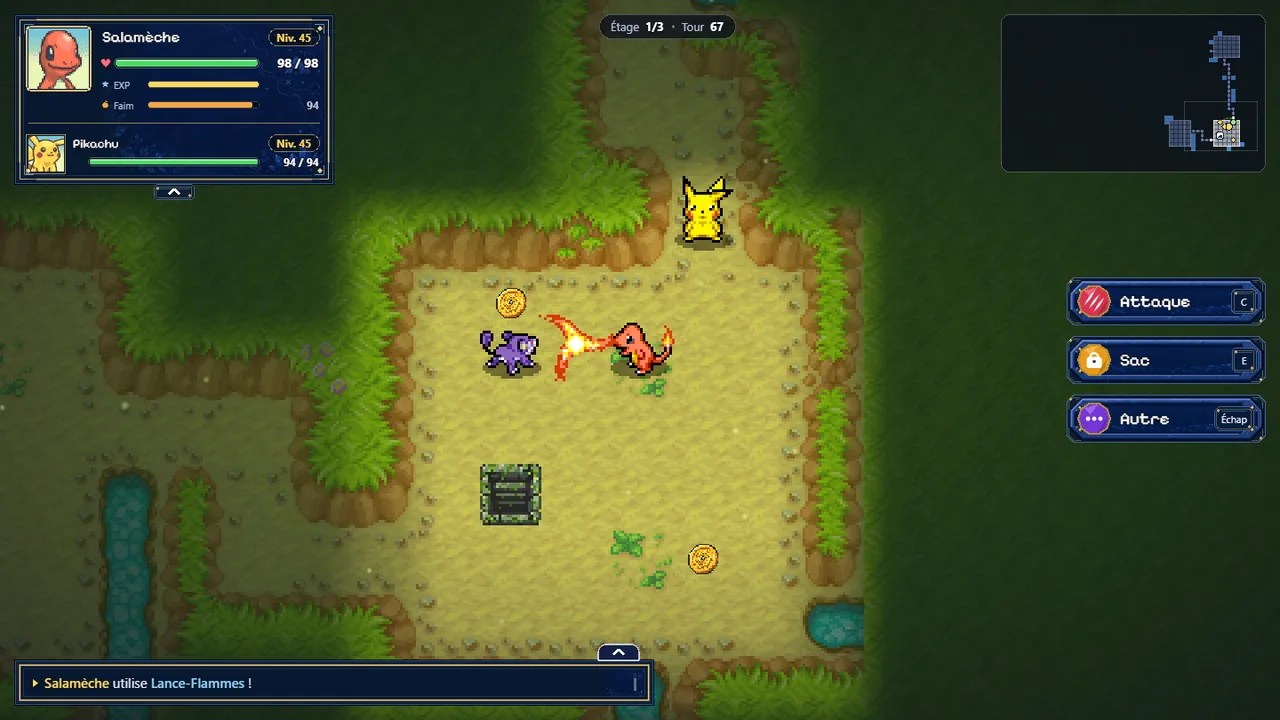
Every step is a turn, and the wild Pokémon act after you. The possible actions, the ranges, what makes up damage, the regular attack, and natural HP recovery.
In short
- A step, an attack, an item, a wait: one turn. Then every wild Pokémon in sight takes its turn.
- Four moves with their PP; when they are at zero, the regular attack, weaker, is always there.
- Ranges are those of Explorers: in front of you up to five tiles for moves that reach far, three in a line, five for a thrown item.
- HP comes back on its own, one percent of max HP per turn, twice as fast when things are quiet in the first chapters, up to half of max HP on a single floor.
What you can do in one turn
- Walk one tile, diagonally too; running chains steps as long as nothing turns up, and running into an ally swaps your places.
- Turn in place without spending a turn, to aim.
- Attack: the regular attack in front of you, or one of the four moves.
- Use an item: eat, drink, throw, place.
- Talk to a calmed wild Pokémon, or to Gholdengo.
- Wait one turn, to let them come or let them pass.
- Gather the team: one turn to bring your teammates around you, none if they are already there.
Teammates act according to their tactic, after you; then the wild Pokémon. A wild Pokémon outside your room notices you at two tiles.
Moves and PP
Each Pokémon has up to four moves, each with its PP. A move at zero PP no longer fires; a  Max Elixir restores them all. The regular attack costs nothing and hits the tile in front of you, but it is weak: it is the last resort, not the first. From a Pokémon’s card, you can set a move aside so that its tactic no longer uses it.
Ranges
- In front of you: most moves hit the tile facing you; those that reach far go up to five tiles in a straight line, as long as nothing blocks the way.
- In a line: three tiles, for the moves said to be “in a line”.
- Around and in the room: room moves hit everything within three tiles of the user.
- A thrown item goes up to five tiles, and stops at the first Pokémon it hits.
An invisible wild Pokémon that attacks is revealed right before its hit: you always know where it came from.
Damage
Damage depends on the move’s power, the Attack or Special Attack of whoever strikes, the Defense or Special Defense of whoever takes it, the type (× 1.4 when super effective, × 0.7 when not very effective, × 0.5 instead of an immunity), the weather, stat stages, and a bit of luck. A critical hit ignores defense stages. The full type chart is on the type chart.
Natural recovery
Every turn brings you closer to one HP: the higher your max HP, the faster it goes, that is one percent of max HP per turn. Up to chapter 7, quiet (no wild Pokémon within five tiles) doubles the speed; from chapter 7 on, with alchemy, elixirs do the healing, and quiet no longer hurries it. On a single floor, you only regain half of your max HP on your own, except on Easy difficulty. A starving hero doesn’t recover, and some status conditions cut off recovery.
Pulling back a room to let HP come back is still a tactic, paid in Belly rather than items. It has its limits: the floor’s cap, and the reinforcements that end up arriving.
See also
- BattleStatus conditionsAsleep, poisoned, paralyzed… A status condition changes what a Pokémon can do for a few turns, for it as for the wild Pokémon. Here are the game’s nine status conditions, what they really do, how long they last and how to get rid of them.
- BattleProtections and hindrancesProtect, Safeguard, Light Screen, Taunt, Perish Song… Besides its status, a Pokémon can carry several passing effects, good or bad. What each one does, how many turns it lasts, and which move sets it.
- TablesThe type chartThe eighteen types and their matchups, with the Mystery Dungeon multipliers: × 1.4 when super effective, × 0.7 when not very effective, × 0.5 where the main series does no damage at all.