PDMN, the Pokémon Mystery Dungeon fangame in your browser, changes almost every day. Here is the update log, newest first. It’s also posted on the Discord server.
Memory Tiles: the Shell Game
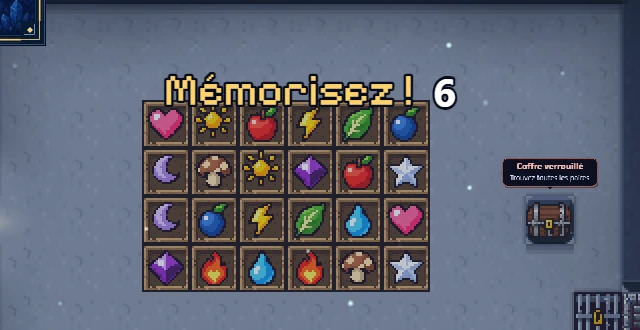
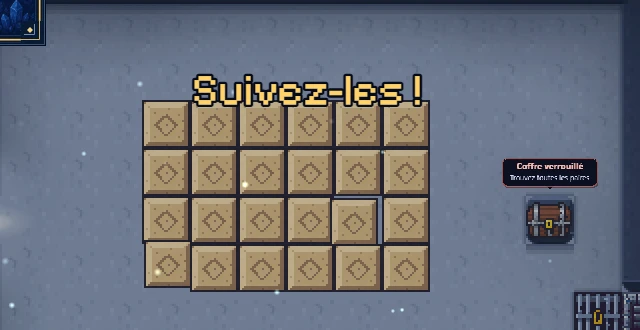
A screenshot is no longer enough: you have to follow the tiles with your eyes. Thanks, Rayne, for pointing it out!
Eight seconds to memorize — the tiles now show themselves for eight seconds instead of five.
The shell game — once they close, four pairs of tiles trade places before your eyes, one after another: follow them to know where each symbol went.
Cheating with a screenshot — a photo of the preview no longer gives the right layout.
No More Ghost Snoring
Two reports, two fixes. Thanks, Rayne!
The little stop at every step — a wild Pokémon asleep at the far end of the floor snored every turn, even out of sight, and made each step pause; it now sleeps silently.
The crash when signing in — on Chrome for Android, the browser’s autofill on the sign-in form could crash the game; that’s fixed.
The Hollow Comes Alive, Day and Night
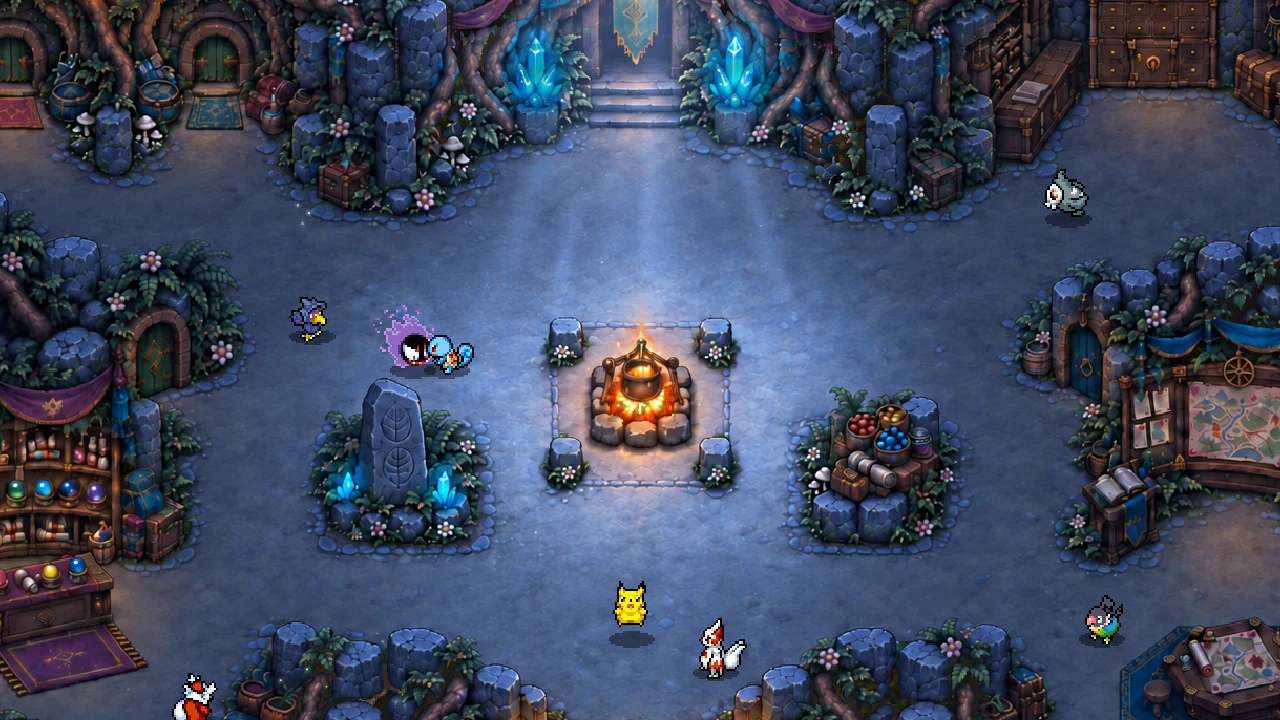
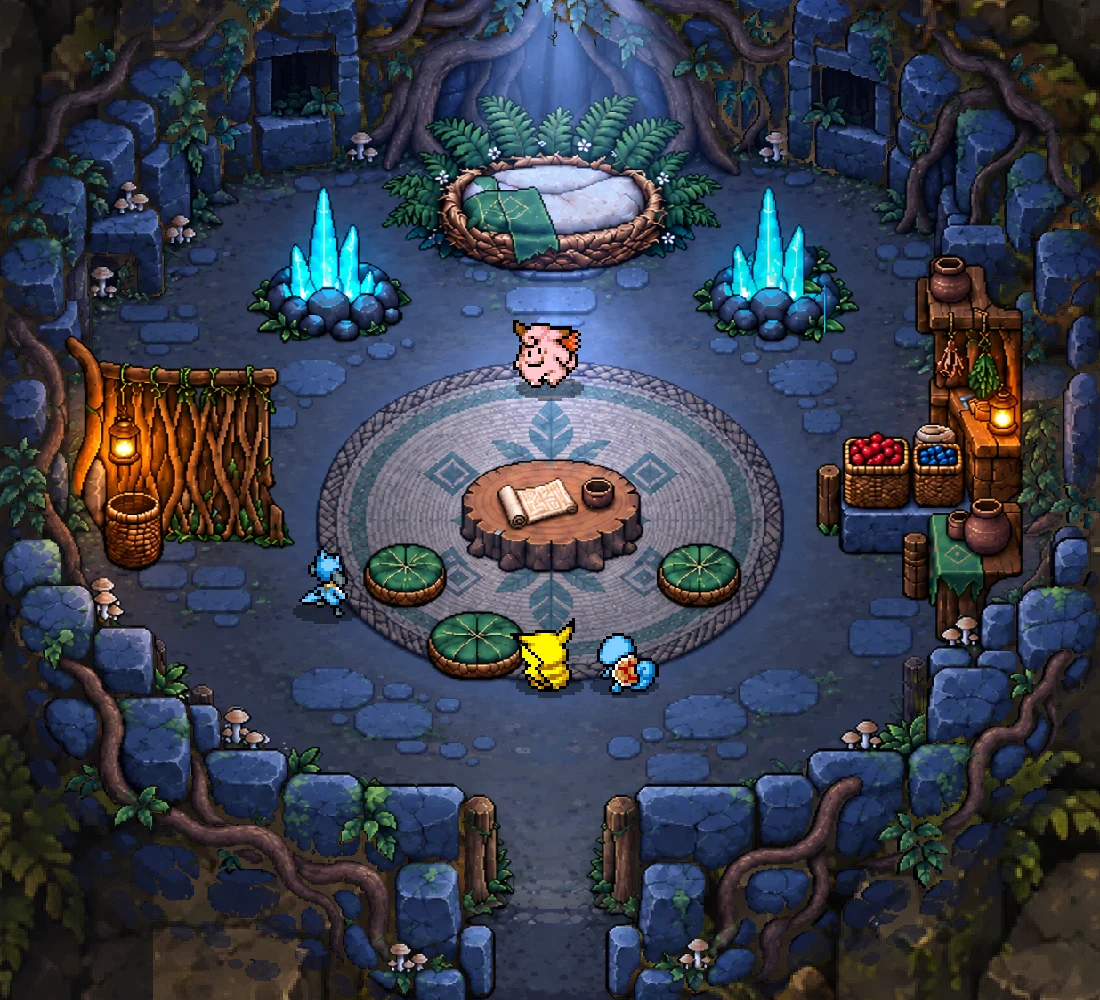
The lanterns breathe, the cauldron steams, the fireflies dance. And at 10 p.m., night falls over the Hollow.
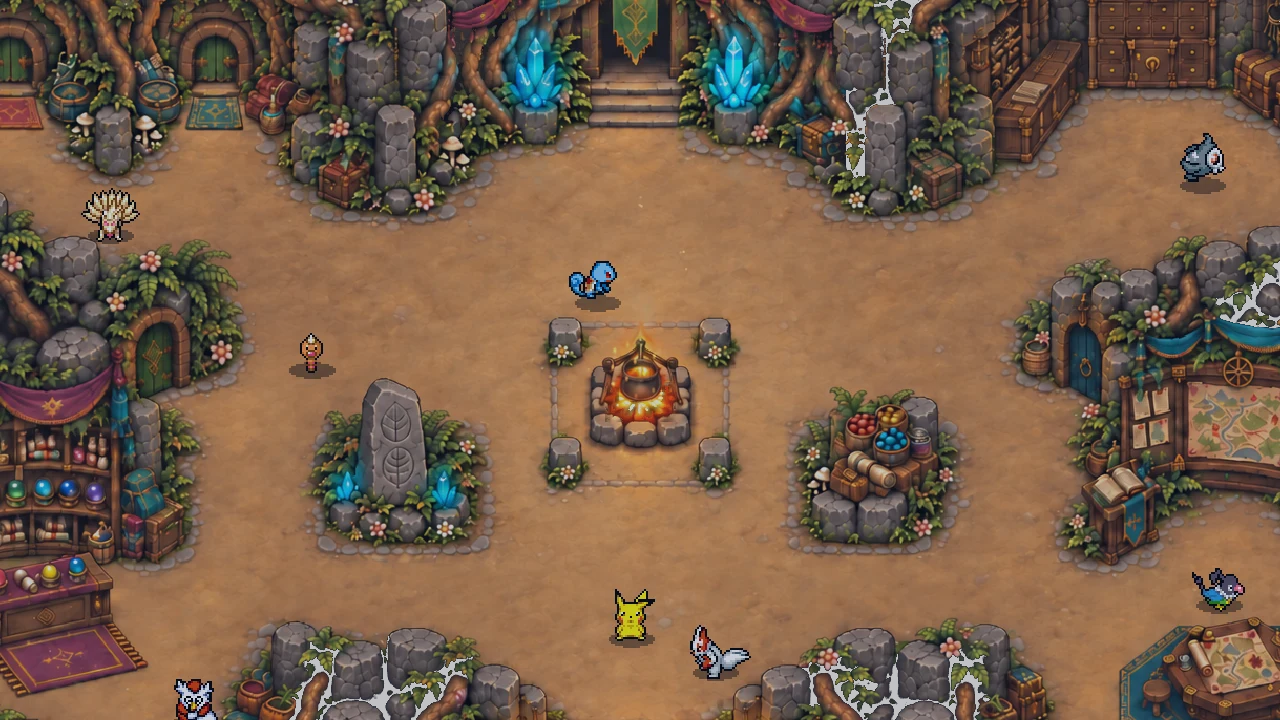
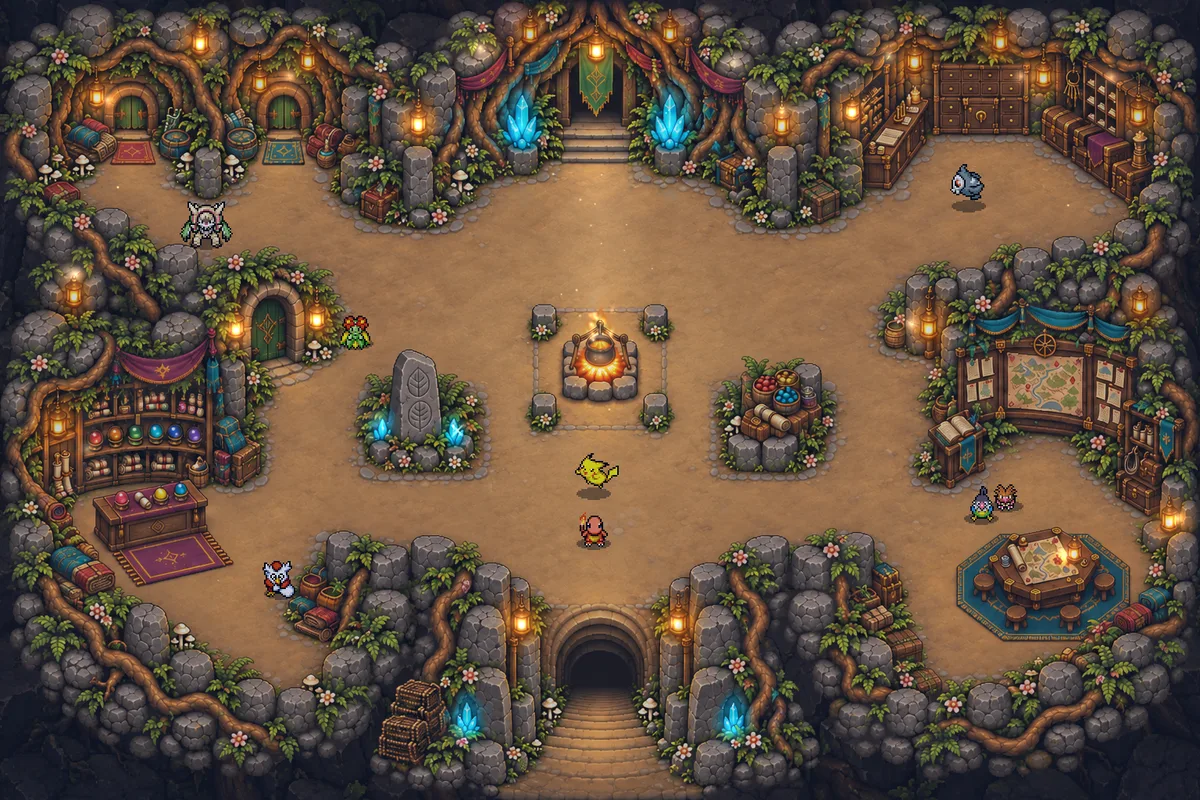
A new Hollow — the great hall is repainted, with one more door by the big board… which doesn’t open yet.
A living backdrop — lanterns, the cauldron fire, steam, crystals, hangings and fireflies never stop moving in the great hall.
Night falls at 10 p.m. — on your own clock, until 8 a.m.: the Hollow, the dormitories, the Sparkle Garden, your room, the elder’s den and the Dew Garden switch to their night look, animated too.
The Hollow empties — squatters, little ones and visiting teams go to bed; the keepers and the main characters stay, and your partner keeps watch with you.
The garden by moonlight — in the Dew Garden, the lanterns breathe, the water and crystals shimmer, and your shoots take on the colors of the night.
Night watchers — nocturnal Pokémon come out once everyone is asleep, with lines of their own.
Live — if you’re playing when the hour turns, night falls (or day breaks) before your eyes.
Recruits go to bed earlier — in the dormitory, they now sleep from 10 p.m. instead of midnight.
Three Saves per Account
Replay the story, try another duo or tag along with a beginner friend, without losing anything. An idea from Rayne.
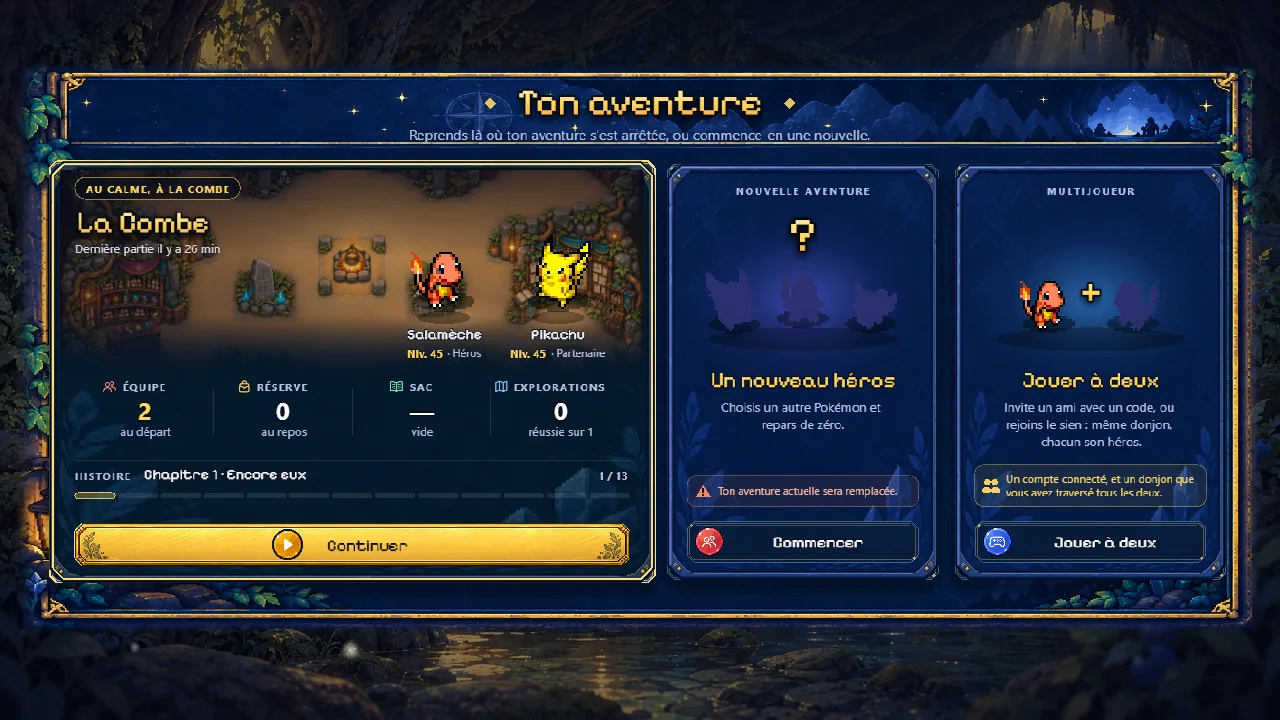
Three saves — on the adventure screen, three tabs “Save 1 · 2 · 3” show your hero and chapter in each; one tap switches between them.
A free save — start a new adventure there: the others wait, untouched.
Each has its own things — the Hollow, the team, the bag, the bank, the coins and the story belong to each save; nothing moves from one to another.
One Journal — your discoveries, Achievements and titles stay the same, whatever the save.
Kept online — with an account, all three saves are stored on the server, like the current one.
Doors You Pass Without Aiming, and Visitors in a Hurry
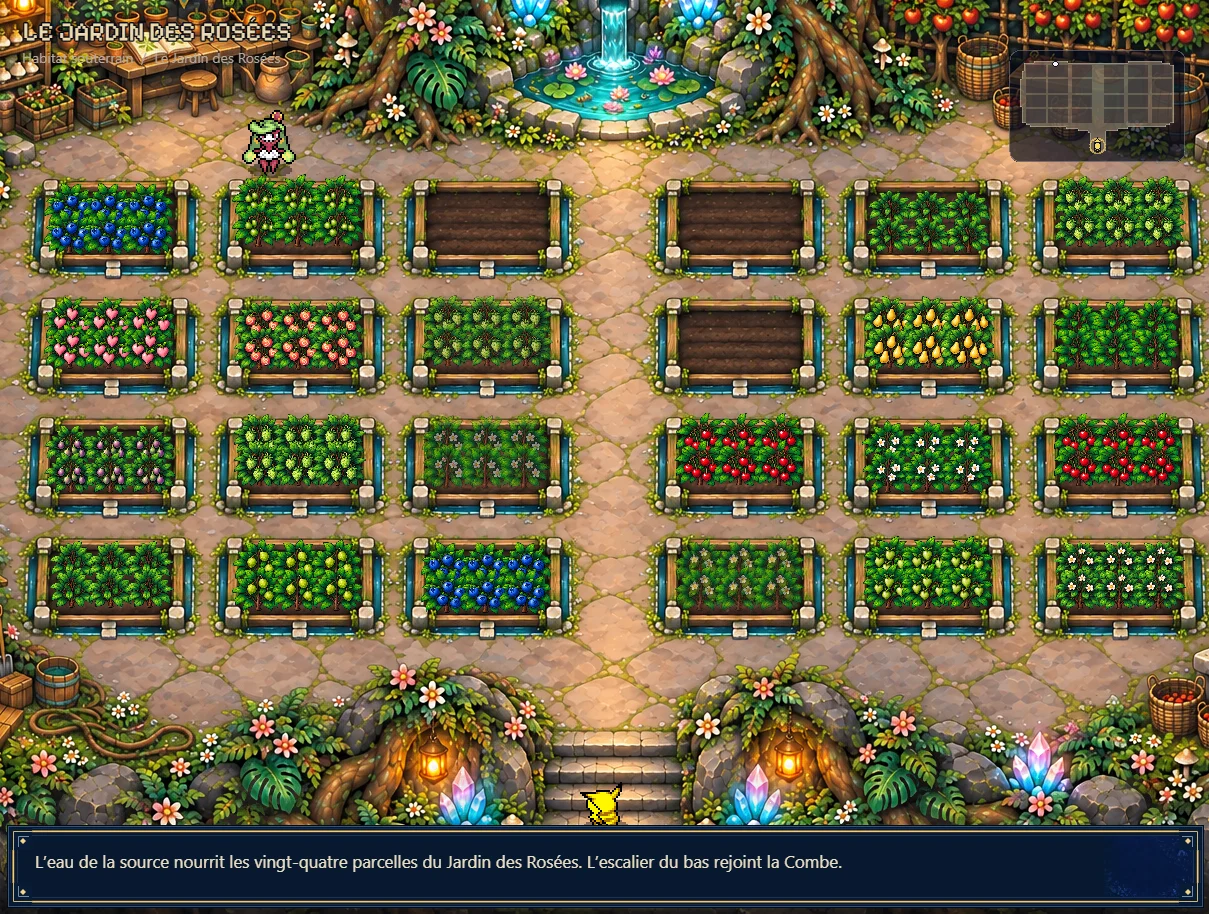
Leaving the Dew Garden — the whole bottom of the stairs leads back to the Hollow, edge to edge: no more hunting for the one right tile.
Thresholds the right width — the burrows, the chief’s burrow, the Garden arch and the Sparkle Garden can be passed across their whole entrance.
Pushing against the wall next to it — a narrow door can also be taken by pushing toward it from the tile beside it, without lining up exactly.
Visitors in a hurry — a quest client appears right nearby to talk, and those in a scene reach their spot at a brisk pace, or instantly if they are far.
On phones, the bottom of rooms is back — the text box hid the bottom of the Dew Garden stairs and the departure tunnel; the view now rises above it (thanks Rayne).
The Dew Garden
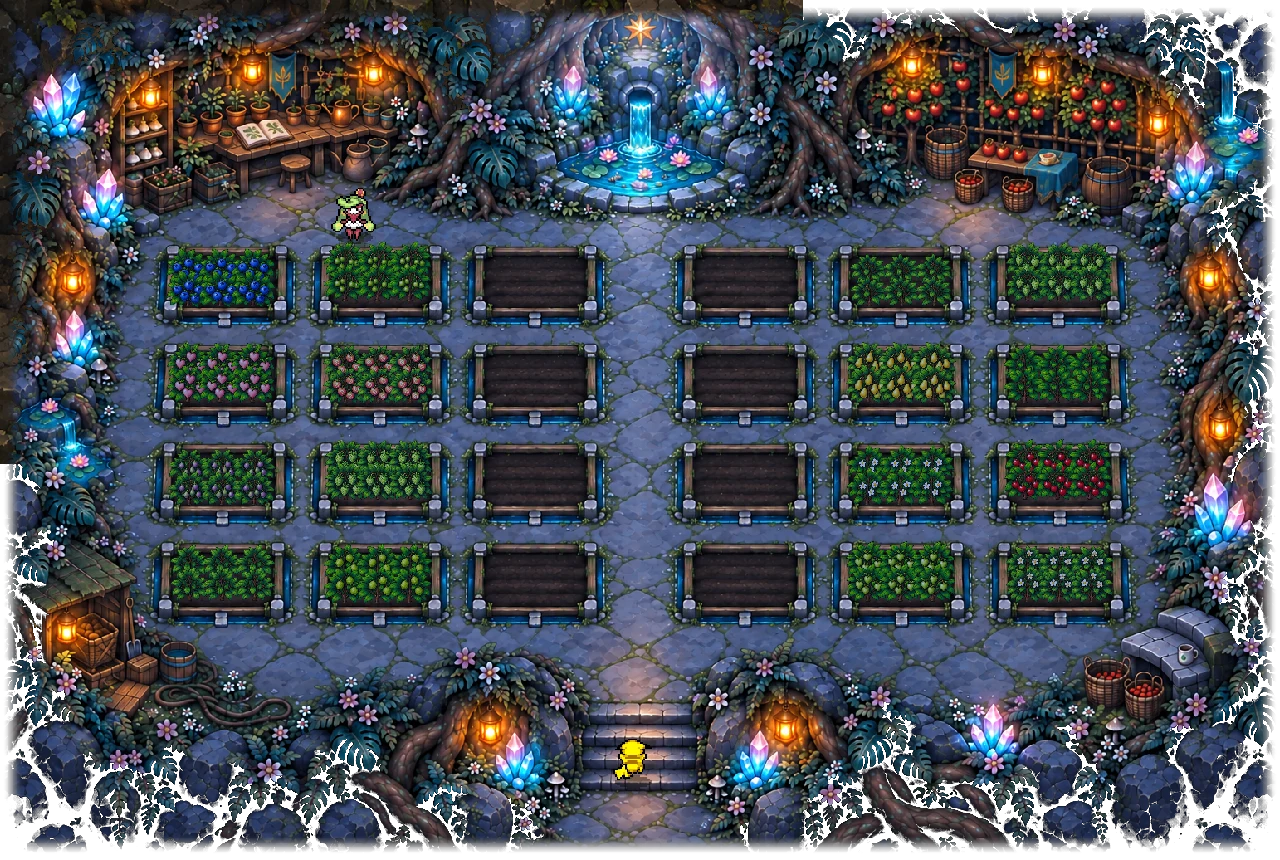
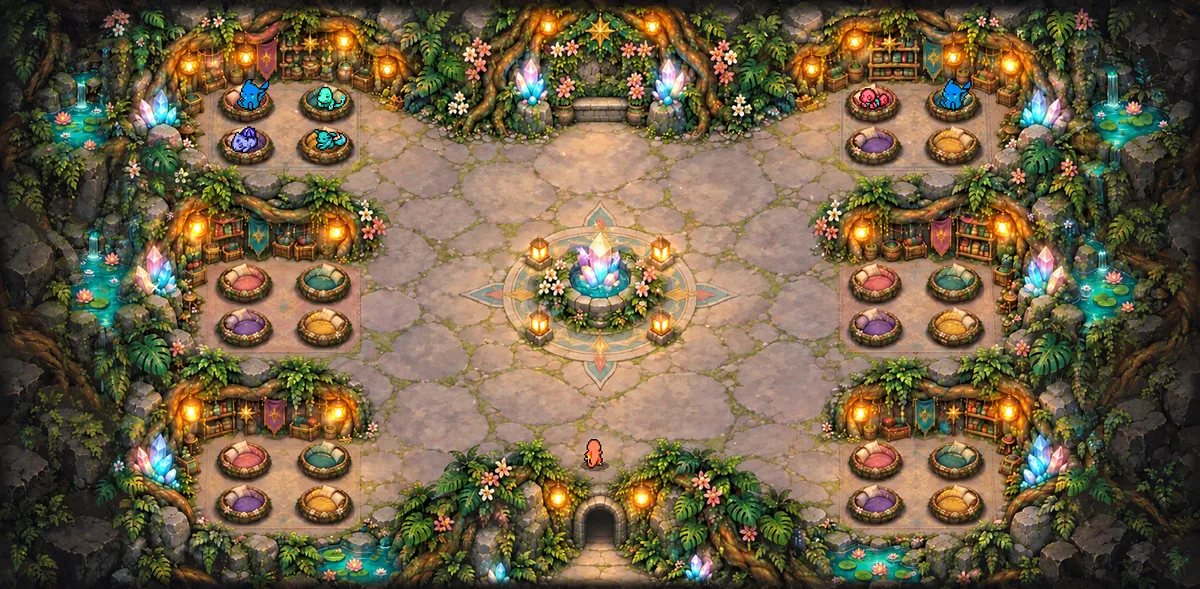
A new room opens in the Hollow: Tsareena grows her berries there, and lends you eight beds.
A new door — the flowered arch next to the shop leads to the Dew Garden; you can visit it right away.
Shoots in dungeons — now and then a berry shoot lies on the floor: Oran, Sitrus, Pecha, Cheri, Chesto, Persim, Aspear or Rawst.
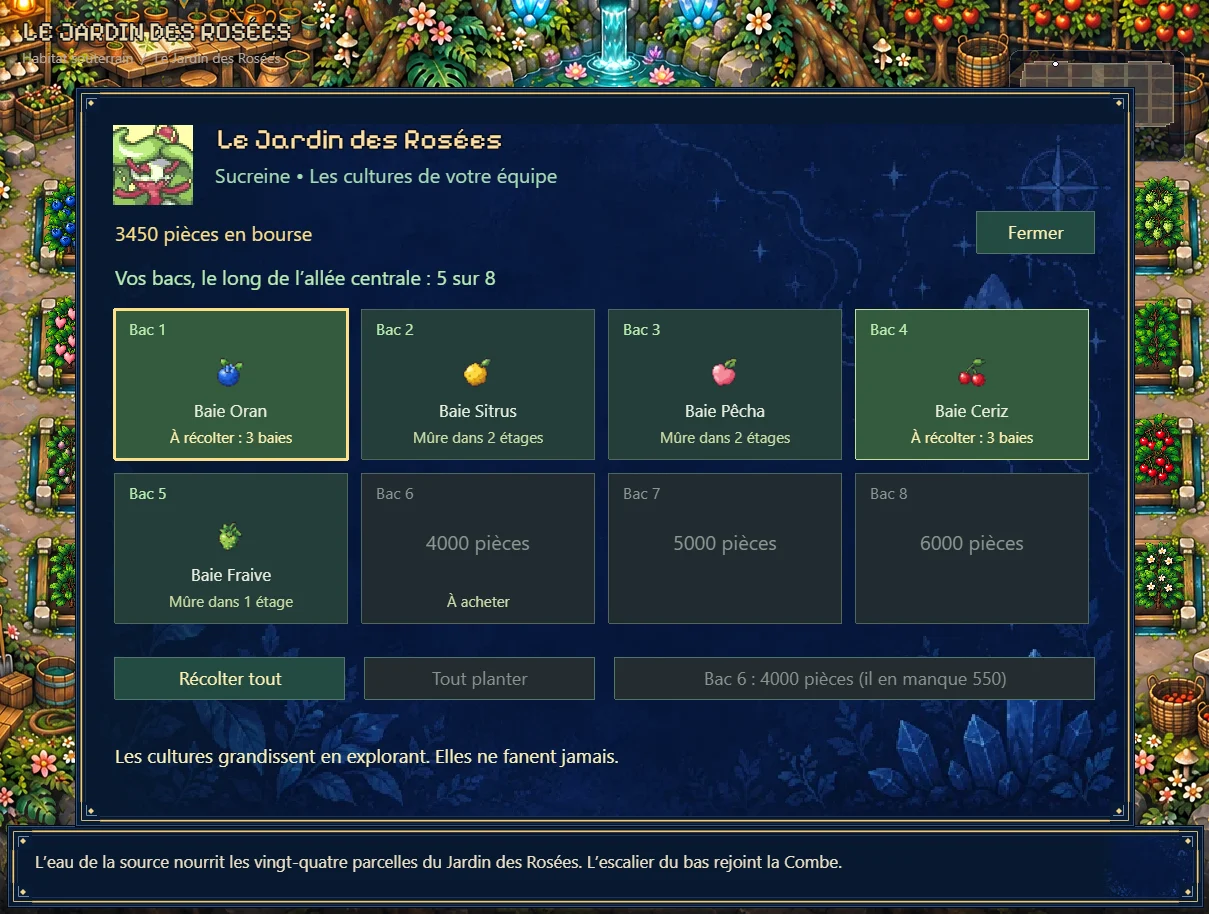
Eight beds of your own — after your victory in the Deep Roots, Tsareena sells you the beds along the central path one by one, from 200 to 6,000 coins.
Plants that grow back — every floor you clear makes your crops grow; three berries every four floors, a single Sitrus every six, then the plant starts again.
Nothing is lost — a harvest your bag can’t take waits in Skelénox’s chest.
Harvest all, plant all — Tsareena’s window handles all eight beds at once; digging a plant up gives you its shoot back.
Hollow scenes no longer keep you waiting — whoever comes to talk walks over briskly, or fades in if they are far away.
The garden is under construction — for now, you can’t plant or harvest; go and talk to Tsareena to find out more.
The shop is closed — to find out more, go and talk to Delibird.
Fewer berries in dungeons — from chapter 5 on, there are 30% fewer berries on the floor and at Gromago’s: the garden takes over.
Room for Conversations
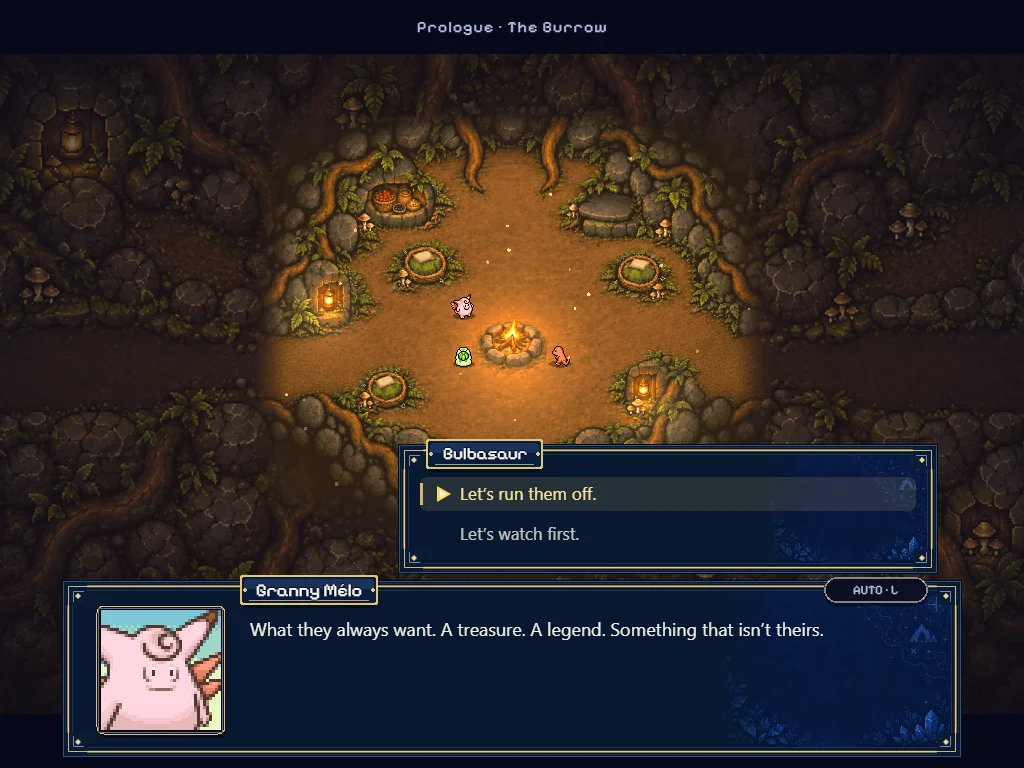
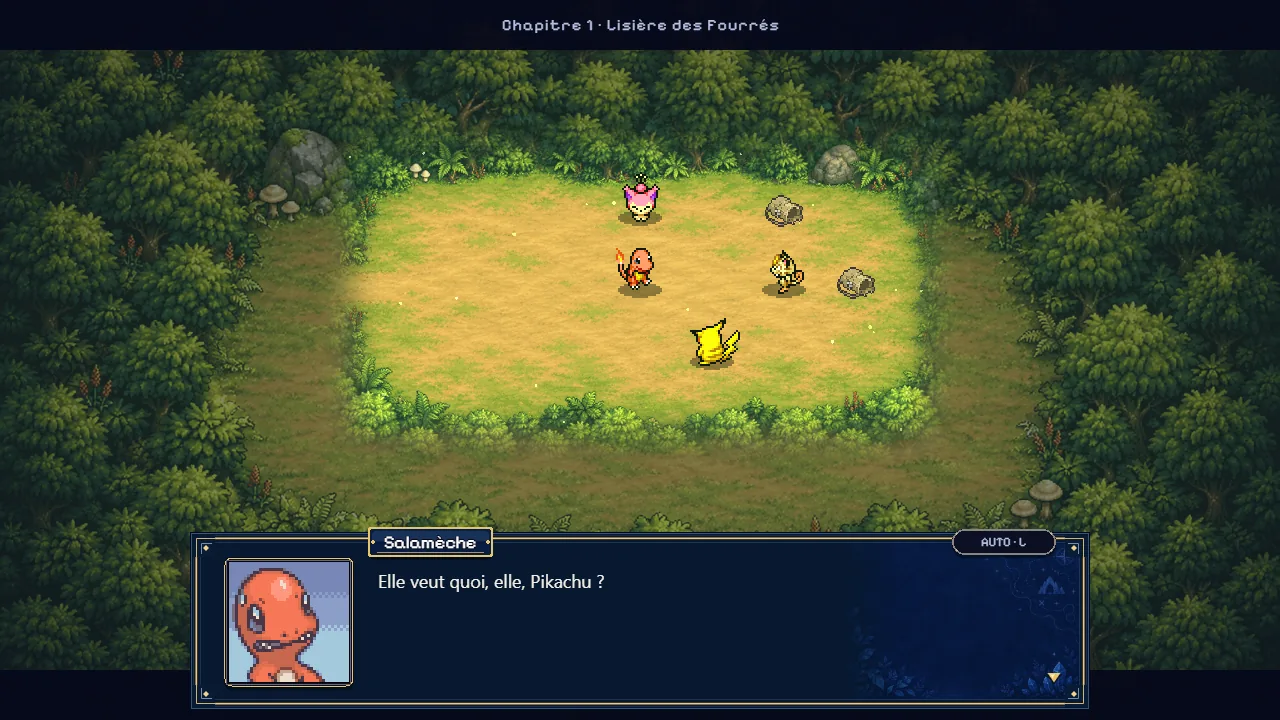
The Hollow makes room — during a story scene or a quest hand-in, the Pokémon not taking part fade away for the conversation, then come back to their spots.
Who stays — your duo, whoever is speaking, and the keepers behind their counters.
Holding On in the House, and a Journal With Style
In the Monster House, the team fights to the last; and the Exploration Journal is finally worth opening.
A teammate takes over — if your Pokémon falls in the House, a teammate still standing takes the lead and the fight goes on. Reported by Rayne.
A defeat you understand — the House is only lost if the whole team falls: the screen darkens and a scroll explains what happens before the next floor.
Victory heals — a Monster House beaten restores the whole team to full HP, even those who fell during the fight.
The Exploration Journal redone — tabs with their counters, a completion gauge, portraits for Alphas and shinies (in their true colors), medallions for encounters and titles.
Wanderers and pages — each wanderer shows how far along you are (met, beaten, recruited), and the vanished explorer’s pages read on parchment.
The “teleport” out of the House — it wasn’t one: the fall of the Pokémon you control alone sent the whole team out, without a word.
The Monster House Wakes Up
Three looks, equipped and smarter guards, shinies to catch… and a defeat that no longer ends your run.
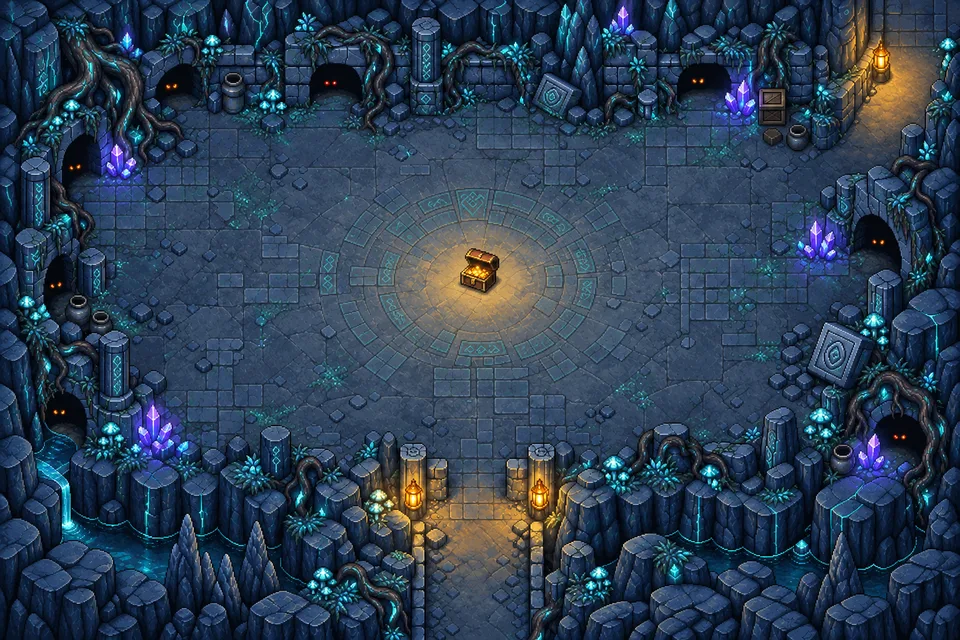
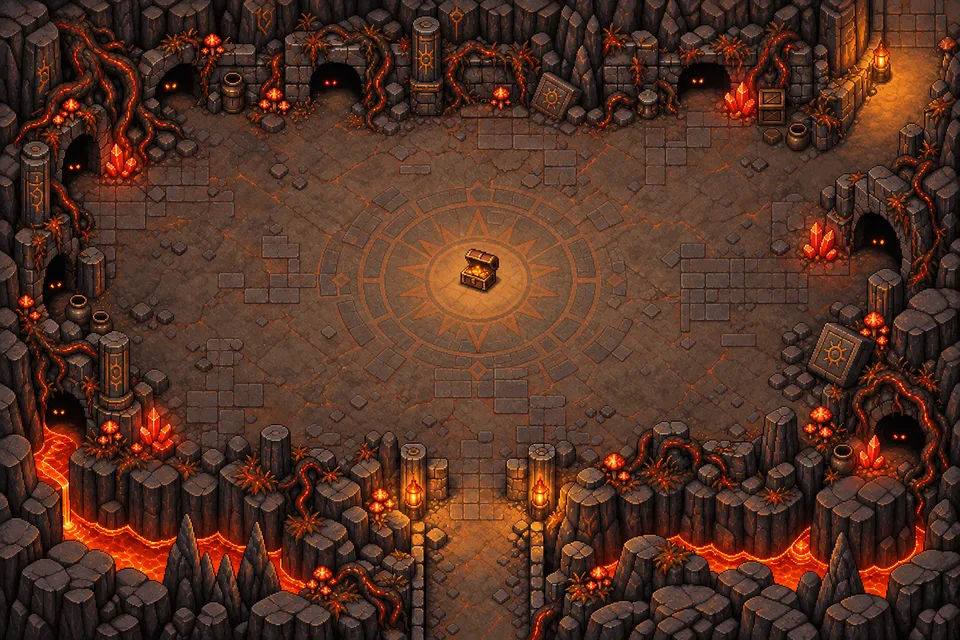
Three looks — the old ruins, a crystal crypt and a volcanic sanctuary; a lava dungeon always gets the volcano, elsewhere each House rolls its own.
Equipped guards — each holds what helps it (band, scarf, Scope Lens) and carries a berry to eat or something to throw; what they carried ends up in the chest.
Smarter guards — they hinder more often, target the Pokémon you control first and go after the weakest member of the team.
Titled and shiny — a guard can bear a title (Swift, Armored…) or be born shiny: far tougher, but if it joins you, it keeps its colors, its title and its item.
Shinies are earned — one time in 40 in a dungeon that matches your team; in a place far below your level, only one time in 100, like ordinary wild Pokémon.
A chest worthy of the place — lean in the first dungeons, complete with its Sealed Box from the middle of the story on: going back to the Thickets no longer pays as much as a distant House.
A defeat that cost everything — wiped out in the House, the team is now thrown out to the next floor, bag included, without the treasure; the run goes on.
An Entrance That Growls
⚠️ Story spoilers (chapitre 3): details are hidden, hover or tap the bars to read them.
Staged fights have their own music — as soon as a blow lands in a scene, the music switches to a boss theme: Rescue Team's in Act I, Explorers of Sky's in Act II, Gates to Infinity's in Act III.
Too gentle a tune at the end of Chapter 3 — when Balafre bursts in on the beaten explorers, the scene played a peaceful air; it now plays "Outlaw!", the outlaw theme from Explorers of Sky.
A Name for Every Recruit
Your Pokémon in the Hollow can finally carry the name you pick for them.
Rename a recruit — in “Build the Team”, the “Rename” button at the end of their name opens a field: up to 12 characters, accents included.
Go back — “Original name” gives them their species name again, at any time.
A name that lasts — the nickname follows them everywhere, in dungeons as in the Hollow, and stays after they evolve.
A few rules — the hero and partner keep theirs, two camp members can’t share a name, and a species name is refused so they’re never mistaken for a wild Pokémon.
A View That Stays Put
The view no longer wanders off — on a computer, the mouse at the screen edge and right-click drag only move the camera while the big map is open; closing it brings the view back to your Pokémon.
The log scrolls — the mouse wheel finally scrolls it, you can also drag it with the mouse or a finger, or grab its bar; a simple click still enlarges or folds it.
The Map as a Minimap, and the Menu Is Back
On a computer, the map shows the dungeon live; by touch, the Ice Rink finally slides.
The map as a minimap — on a computer, press and drag on the map: the dungeon view follows the pointed spot, live, like in League of Legends; a simple click still enlarges the small map, and right-click drag scrolls the big one.
The Ice Rink by touch — tap a tile on the same row or column as your Pokémon: it slides off that way. Reported by Rayne.
The silent menu in dungeons — since the big map’s cross last night, the Menu button and Escape no longer opened the menu; fixed.
The thank-you crash — reported by Rayne: in the Hollow, a client coming to thank the team could vanish mid-scene and crash the game.
The Big Map Closes
A cross on the big map — top right, next to the “?”: one click brings it back to the small corner map, and Escape does the same.
Two Players, a Tougher Dungeon
More wild Pokémon, more surprises, and the Monster House and mini-games finally open to two players. An idea from Rayne.
More wild Pokémon — with two players, every floor is far busier: co-op is no longer a stroll, it plays about as hard as solo.
More surprises — Alphas, rare encounters, Monster Houses and mini-games show up one and a half times as often, and rare items are easier to find.
The Monster House for two — its stairs are offered to your friend; you go down and fight together, and the promised recruit goes to whoever defeats the last guard.
Mini-games for two — Minesweeper, Memory Tiles and the Ice Rink: whoever found the golden stairs plays, the other watches from the side and gets control back at the end.
A share of the chest each — all the loot for one, all the loot for the other: what one takes isn’t missing for the other.
The price of co-op — fainting or fleeing with two players also costs the Pokémon recruited during the run; clearing the dungeon or an Escape Orb brings them home.
Lists That Slide Under Your Finger
At the Move Master and at Duskull’s bank, you scroll by touch, just like on the departure sheet.
The Move Master by touch — swipe the team list or the forgotten moves to scroll them; a simple tap still picks the line. An idea from Rayne on the server.
The bank chest too — a long chest scrolls when you swipe it, and tapping an item selects it as before.
The mouse wheel — on a computer, it scrolls the forgotten moves just like the chest; dragging with the mouse works too.
The crash when coming back on Android — reported by Rayne: returning to the game after visiting another app could crash it; now the page restarts by itself and you pick up where you left off.
The Backgrounds Are Back
Tonight, a green frame had replaced the rock around the Hollow and the dens: fixed, and guarded against from now on.
The rock is back — around the Hollow, the Sparkle Garden, the dormitory and the dens, the backgrounds show again instead of a green frame.
Tonight’s green frame — for a few hours, the site went out without part of its images, and the browser kept the wrong answer in memory; if you still see green, reload the page.
A missing image no longer leaves a hole — the game fetches the original right away, and the screen stays painted.
A real “not found” page — an address that leads nowhere now says so, instead of sending back the home page.
No More Silent Black Screens
When the game crashes, it says so, and warns the team by itself.
A scroll instead of the black — if an error stops the game, Chatot brings a scroll: what happened in one line, and a button to reload. Your game is saved every turn, you pick it up where you left off.
The report sends itself — the error, the save and the log reach the team just like with “Report a bug”, with nothing to do.
The Site Scrolls Again
Below the title screen, the game’s presentation is back.
The page frozen on the title screen — since September 25, it was impossible to scroll down to read the presentation, the guide and the starter Pokémon: the achievements banner, which keeps watch at all times, made the page believe a game was in progress. That’s fixed.
The Map, and a View You Can Move
An idea from Elsa on the server: read the map better, and look around.
A real legend — the “?” button on the large map (or the K key) explains every marker: your team, wild Pokémon, the terrain, stairs, each kind of item and each trap by its color.
Explore the large map — drag it, zoom with the mouse wheel or two fingers; tap the small map to enlarge it.
A free camera — like in League of Legends: the mouse at the screen’s edge, a right-click drag, or two fingers on a phone move the view around the floor, without using a turn.
Back to the hero — the view returns as soon as they act, or with a tap on “Back to hero”.
The large map spilled over on phones — it went under the journal and off the screen; it now sits next to your team.
Traps invisible on the map — the Seal Trap and the Explosion Trap, too dark, now have a light outline.
The Sheet of the Pokémon You Tap
In “Build the Team”, by touch, one tap first shows the sheet.
One tap, the sheet — on phones, tapping a Pokémon in the list shows its sheet on the right: its moves, its item, its stats, and the button to its tactic and “Release”. An idea from Rayne on the server.
A second tap, the action — tapping it again adds it to the team or sends it to rest, as before. With a mouse, nothing changes: hovering shows the sheet, clicking acts.
The Bot Speaks English
The server’s bot now answers you in English or French.
Pick with /language — the bot talks to you in English or French, and remembers your choice.
Otherwise, Discord decides — if you don’t choose, the bot follows your Discord app’s language.
The whole bot, translated — Pokémon, move, item, type, dungeon and chapter sheets, your profile, Achievements and the leaderboard, in the English game’s own words.
An “English” button — under announcements, What’s New posts, bug and idea cards, earned Achievements and the relay updates: it shows the English version to whoever clicks, and only to them.
Commands in English — with Discord in English, they’re called /item, /move, /dungeon, /profile, /achievements, /leaderboard…
Thank You, Team!
A successful mission is no longer just one line in the report.
The client comes to thank you — every time you return, whoever signed the request is waiting for you in the Hollow, thanks you and hands over the reward.
News from the valley — each one shares what worries or delights them, and what they say changes as the story goes on: worried, surprised, sad or relieved.
The hero speaks up — the hero and the partner answer, each in their own way.
Mail on the road — when the Hollow’s residents are far from you, Chatot brings you their note and reads it aloud.
Nineteen clients — from the Hollow’s residents to the exploration teams met along the way, each with their own voice, in French and in English.
Simpler on Phones
Dungeon menus by touch, and an iPhone that finally starts the game.
Menu goes straight to Other — by touch, Moves and Bag already have their own buttons: Menu now opens waiting, stairs, team, settings and fleeing directly.
PC buttons behind the windows — reported by Rayne: opening the Bag or Moves by touch made Attack, Bag and Other show up in the background.
English page stuck on iPhone — Safari stayed on the loading screen; and if the game can’t start, that screen now says so instead of freezing.
Lighter Into the Unknown
Exploring a floor costs less computation with every step.
A step no longer redraws the whole floor — only the tiles you just uncovered, and their surroundings, are re-read; the shadow is only recomputed when it changes, and no longer animates for nothing.
Stutters in unexplored ground — reported by Rayne: light and tiles were recomputed in full at every step, discovered or not; on a modest machine, each step could make the picture hiccup.
Entei Brings the News
When an update comes out while you’re playing, the game lets you know.
A scroll for every update — if a new version of the game comes out while your page is open, Entei comes to tell you.
What’s new in one click — a button takes you straight to the Discord server to see what changed.
Refresh without losing anything — your game is saved: you’ll find it just as you left it, in the right version. “Later” brings it back half an hour later.
Never in the middle of a co-op run — the scroll waits until the run is over, so you don’t lose anything.
Playing Together, Nothing Gets Lost
Fixes that came from your feedback, mostly for playing together.
Everyone at their own level — in co-op, each team plays at its real level, capped at the dungeon’s limit just like solo: no one is dragged down to the other’s level, or stuck while the other grows.
The stairs no longer wait forever — an offer to go down or leave with no answer goes through on its own after 20 seconds, and the banner shows the countdown on both sides.
Leave alone — at the dungeon’s exit, the guest can head home alone with their share (team, recruits, bag, purse) while the host carries on.
A warning before leaving — closing the page in the middle of a co-op run asks for confirmation: nothing is saved until the end.
Oversights in English — the Hollow’s banker is now rightly called Duskull, Granny Mélo becomes Granny Clef, and no line stays in French in the English version anymore.
The Games’ Music in the Scenes
Every story scene now plays real Pokémon Mystery Dungeon music.
One track per place — twenty-nine tracks from Rescue Team, Explorers of Sky, Gates to Infinity and Super Mystery Dungeon, chosen chapter by chapter: Tiny Woods at the edge of the Thickets, Lapis Cave in the Cave of Cries, and so on to the end.
The burrow has its tune — Rescue Team Base when you wake up and every time you come back to Granny Mélo’s, Friend Area ~ Forest at the camp on the road.
The music follows the mood — it changes in the middle of a scene when the tone does: an apparition, a farewell, a turning point, and sometimes silence.
The remixes stay — on the title screen, in the Hollow, in dungeons and against bosses, nothing changes.
The Real Sound Effects
The sounds of Explorers of Sky replace everything that was synthesized.
Every move has its sound — Ember, Thunder Shock, Growl, Tackle… each plays the sound effect the games give it, when its motion starts and when it lands.
Hits, misses, the stairs — neutral, super effective or not very effective hits, dodges, stairs, items picked up, berries eaten, coins: all of it comes from the games.
Statuses, traps and weather — paralysis, sleep, confusion, the sleeper’s snoring, every trap, rain and sandstorms rising.
Menus and fanfares — cursor, confirm, back, error, and the fanfares for level-ups, recruits, dungeons cleared or lost.
The scenes too — emotion bubbles, letters, anger, grief, apparitions, the Molt and the Awakening, shoves, tremors, rockslides, thunder and lava.
Ambient sounds — the wind of the passes and the rain of storms loop straight from the games; the gallery’s drops, the rift’s bubbles, the rustling and birds of the thickets come from them too.
Synthesized sounds — they now only serve for a fraction of a second, while the files arrive.
PDMN Speaks English
The whole game and the whole site now exist in English: one button is all it takes.
Français | English — a button at the top of the title screen and the site switches languages, and the game follows.
The whole game translated — story, the Hollow, dungeons, menus, items, moves, quests and achievements, with the official English Pokémon names.
The site too — pdmn.fr/en, with the guide, the starter Pokémon and What’s New in English.
Play together, whatever your language — a French player and an English player can explore the same dungeon, each in their own language.
Account emails — activation and password emails arrive in the player’s language.
Every Place at Your Fingertips
On phones, the departure sheet finally shows every dungeon you’ve already been through.
The list of places scrolls by touch — on the departure sheet, swipe the list to find every dungeon you’ve already been through; a simple tap still picks the place: an idea from Rayne on the server.
Mouse wheel and little arrows — on computers, the mouse wheel scrolls the list, and the arrows at the top and bottom of the list can be clicked too.
Keyboard arrows in “Build the Team” — since the last update, they no longer switched Pokémon in the team list or in the tactic settings; that’s fixed.
The Deep Gallery Gets Its Name Back
⚠️ Story spoilers (chapitres 12 et 13): details are hidden, hover or tap the bars to read them.
After the end of the story, you finally know where to head down.
One name — the post-story exploration is now called “The Deep Gallery” everywhere: at the top of the departure sheet, in the return summary, on the floor map and at the stairs.
Granny Clef shows the way — once the story is over, her first words tell you where to head down.
A scene that got lost — the return to Granny Clef’s after chapter 12 didn’t play if you went straight on to the Epilogue; it now waits for your next visit to her den.
Saves That No Longer Go Backward
Playing on two devices no longer costs you progress.
An old game overwriting the new one — a tab, a phone or the Discord Activity left open on an older game could send it back to your account as soon as it saved; your account no longer goes backward.
Automatic resume — a device left open picks your adventure back up on its own when it has moved ahead elsewhere, and the title screen tells you so.
The furthest one, flagged — when two different games are waiting for your choice, the “Two Adventures” screen shows which one has gone the furthest.
Places You Can Hear
Every place now has its own soundscape, and Alphas command respect.
A soundscape for every place — the crackle of the hearth, the wind in the passes, the rain, dripping in the galleries and rustling in the thickets, always soft under the music.
You can hear the weather — in dungeons, the rain falls and the sandstorm blows, and thunder rumbles right after the lightning.
Scenes that rumble — tremors, rockslides and thunder are timed to what happens on screen, and the music dips for a moment under the impacts.
An Ambience slider — in the sound settings, next to music and sound effects, to set this background to your liking.
Better-guarded Alphas — in its room, an Alpha always has two guards a level below its own, who only leave to chase you; no reinforcements or strays ever come in.
Real Shinies
Their official colors, and a second palette that’s even rarer.
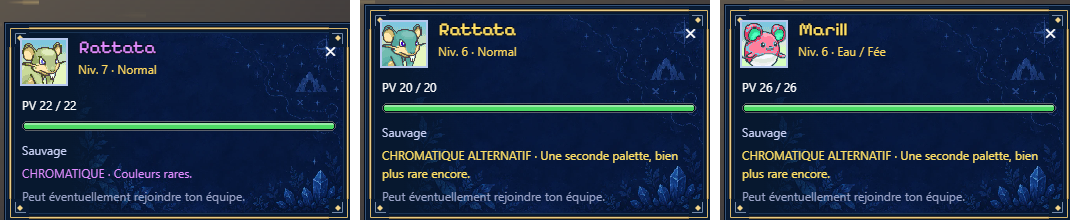
The real colors — a shiny now wears its official colors, the ones from SpriteCollab, in sprite and portrait alike, instead of a randomly shifted hue.
One shiny in five is alternate — a second palette, unique to the game and even rarer, for every Pokémon; it slips away like the others and drops the same Scale.
Recognizable everywhere — two stars and a golden tag in dungeons, on the team cards, in the Hollow and at departure; the Sparkle Garden welcomes it too.
The Journal counts them separately — seen and recruited, next to the shinies, plus an Achievement in their name: Double Star.
A Molt in its own colors — a shiny that molts, in a dungeon or in the Hollow, keeps its colors in its new form.
The Whole Team’s Belly
Shared Ration and Coin Toss are no longer the hero’s business alone.
Shared Ration for everyone — any Pokémon on the team that has learned it can use it: it draws from the shared Belly and heals the allies in the room.
Shared Ration at 3 PP — it had 5: now that the whole team can use it, it’s best saved for tough spots.
A teammate who shares on its own — left to itself, it uses it when a nearby ally is hurt, without ever dropping the Belly below 30.
Coin Toss for everyone — any Pokémon you control can throw coins from the team’s purse; a teammate never spends your coins on its own.
A move taking up a slot for nothing — once learned by a recruit, it stayed unusable because only “the hero” was allowed to use it.
Pay Day with two players — the coins now go into the purse of whoever the Pokémon belongs to.
The Hollow Follows the Story
⚠️ Story spoilers (chapitres 1 à 13): details are hidden, hover or tap the bars to read them.
Every time you come back from a chapter, someone is waiting for you.
A scene at every return — after each chapter, a short conversation awaits you in the Hollow, in Granny Clef’s den or at the bivouac, and it only plays once.
Residents who change with the story — characters you meet along the way settle in the Hollow and change places and lines as the chapters go by: Pikachu and Scar in Act II, then Roc, Dew, Gust and Zenith during the siege.
You’re told where to go — your partner reminds you who is waiting, and so does the bottom of the screen.
After the ending — the valley given back to its residents, an unexpected guest, and a last word from Granny Clef about the Deep Gallery.
Your Feedback
Two ideas from the community, an oversight fixed, and a stele for the Hollow.
The team list scrolls by touch — in “Build the Team”, swipe the list to see all your recruits; a simple tap still picks a Pokémon, and the mouse wheel works on computers too.
Tap-to-walk takes the shortest way — tapping a tile that’s still in the dark no longer sends you all the way around through corridors you’ve already seen: the hero tries the shortest path and corrects course with every step.
The Hollow’s stele — the great stone near the hearth bears the rules of the Hollow: step up to it to read it up close.
The Epilogue you couldn’t find — in chapter 13, the gallery didn’t offer the story’s last scene: it’s now at the top of the departure sheet.
The Adventure for Two
Your friend can now live your story by your side.
A chapter played together — if one of you is at their chapter’s dungeon and the other has already reached it, you can go down together: you watch the scenes at the same time, fight the boss as a pair, and the story moves forward for the one whose chapter it is.
Story allies come along — the Pokémon who join a chapter join the team of the player it belongs to, in place of a teammate.
“Pass” — in battle, a button hands your turn to your friend so they don’t have to wait for you.
The camera follows your friend — when all your Pokémon are down, you watch your friend finish the floor.
Your friend’s team in the frame — their hero appears in your team frame and their Pokémon are shown in turquoise, with a marker on the map to find them.
A brand-new banner — waiting and “Pass” show up in a painted banner, under the floor bar.
A sturdier session — if one of you leaves or loses the connection, the other keeps going and picks them back up when they return, and messages lost along the way are sent again.
The missing fourth Pokémon — with two players, a team Pokémon could be missing from the frame in the top left.
Every Profile on Discord
Even without a linked Discord account, your team shows up on the server.
/profil by username — the “joueur” option looks up a game by its in-game username, with suggestions as you type: accounts created with an email address or Google show up too, with nothing to link.
The Hollow Lights Up
The common hearth gets a makeover.
A more flowery Hollow — the great hall’s illustration has been retouched, with more flowers and greenery.
A ray of light — a warm glow comes down from the upper entrance, with golden dust dancing in it.
The pot is steaming — wisps rise gently from the hearth.
Fireflies and sparks — fireflies blink in the greenery and blue sparks rise from the crystals.
The Dungeon, Seen from Farther Away
On phones, you can see danger coming.
A wider view — on phones, the dungeon is shown from farther away: about fifteen tiles tall instead of a dozen, so you can see the room, the corridors and the wild Pokémon closing in.
Talking to Each Other
A word to your friend without leaving the dungeon, and reunions that no longer fail.
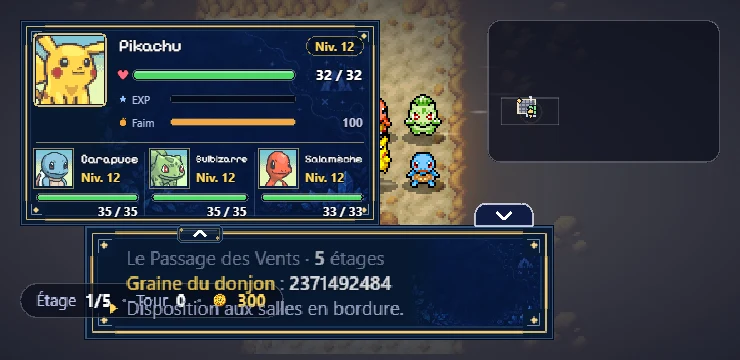
Write to your friend — with two players, the B key (or the Message button on phones) opens a text field: your message appears in a bubble above your hero, with your username.
Messages that stand out — in the log, what you write to each other has its own line, gold for you, turquoise for your friend; two bubbles side by side move apart to stay readable.
Reload in one click — if the game has been updated since your page was opened, the “Play Together” window says so and offers to reload: you both need the same version.
Unable to join — a friend whose page was out of date couldn’t enter the code again after reloading; now they can, and they’re told when the versions differ instead of waiting for nothing.
The Sparkle Garden
Behind the dormitory’s little door, a garden just for your shinies.
The Sparkle Garden — the dormitory’s little door finally opens onto a room of orchids and springs, where every shiny recruit has its own nest.
Dormitories that come alive — during the day, your resting recruits get up and wander around their room; from midnight to eight, each one goes back to sleep in its nest.
A garden that sparkles — waterfalls flow, pools shimmer, petals fall and shards of shifting colors rise from the crystal fountain.
Codes you can read — the code for playing together is written in clear letters, with no way to mix up the characters.
The Joy Ribbon Must Be Earned
A treasure that makes you grow faster should stay a treasure.
A Joy Ribbon too easy to find — it becomes four times rarer on the ground, on Gholdengo’s stall and in wild Pokémon’s bags, as rare as a Golden Apple.
Tactics on the Cards
Each member shows how it fights, without opening its sheet.
Tactics at a glance — in the dungeon’s Team window, each Pokémon’s card shows its tactic (Balanced, Aggressive or Cautious) next to its stats.
Numbers You Can Read
No more 5s that look like S’s or 2s that look like Z’s.
Unreadable numbers in the game — wherever the game writes in pixel letters (menus, titles, floors, counters, site pages), numbers now use a clean typeface, without changing the rest of the text.
Unreadable numbers on Discord — all the bot’s cards do the same, even inside sentences: levels, stats, prices, floors, rankings.
A New /profil Card
On Discord, your explorer card reads at a glance.
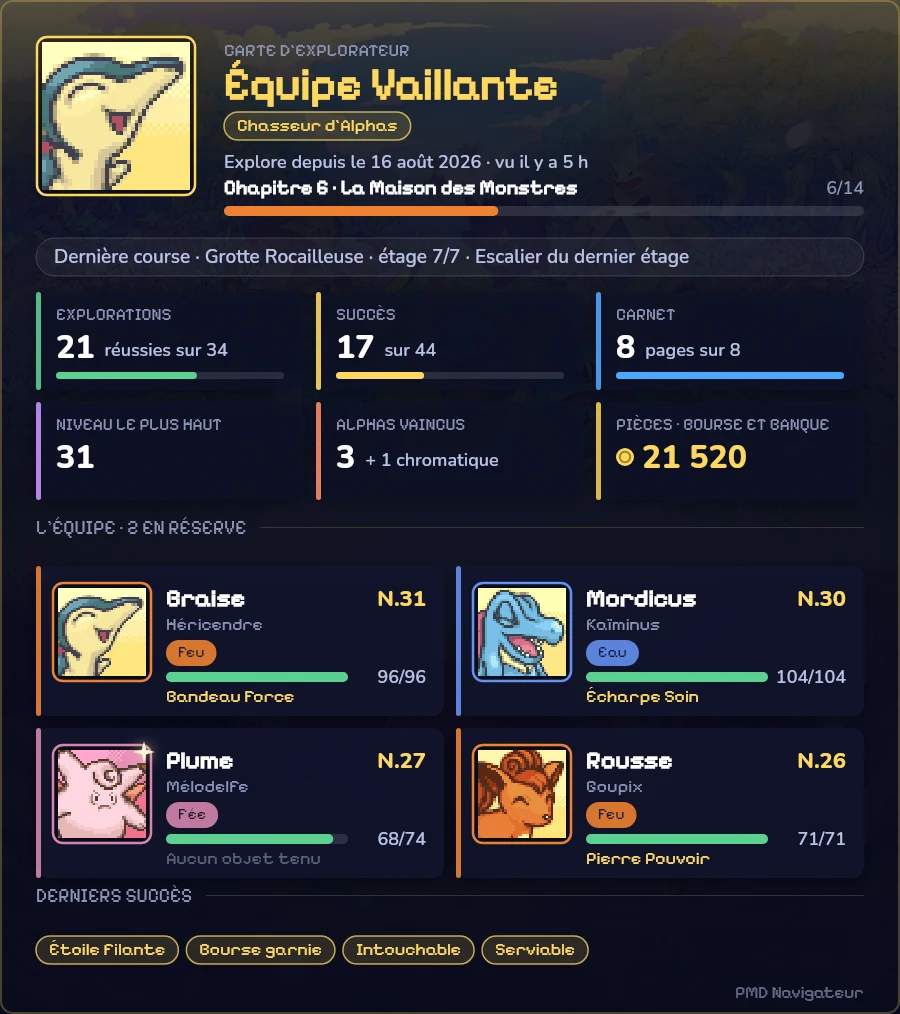
The explorer card — /profil shows your team leader up large, your name, your equipped title, how long you’ve been exploring and when you last played.
The story as a gauge — the current chapter comes with a bar showing how far you’ve come.
Six number tiles — successful explorations, Achievements, Journal pages, highest level, Alphas defeated and coins, each one shown big.
The team side by side — your Pokémon on cards, two by two, with level, types, health and held item, plus the number waiting in reserve.
What you’re up to — your current exploration, or your last run, then your latest Achievements at the bottom of the card.
Unreadable numbers — on all the bot’s cards, numbers are written in a clean font: no more 5 that looks like an S.
The Team as Cards
On phones, your team reads at a glance without hiding the dungeon.
The team as cards — on phones, the expanded team lines up as cards side by side under your Pokémon (portrait, name, level, HP) instead of a list that ran halfway down the screen: an idea from Rayne on the server.
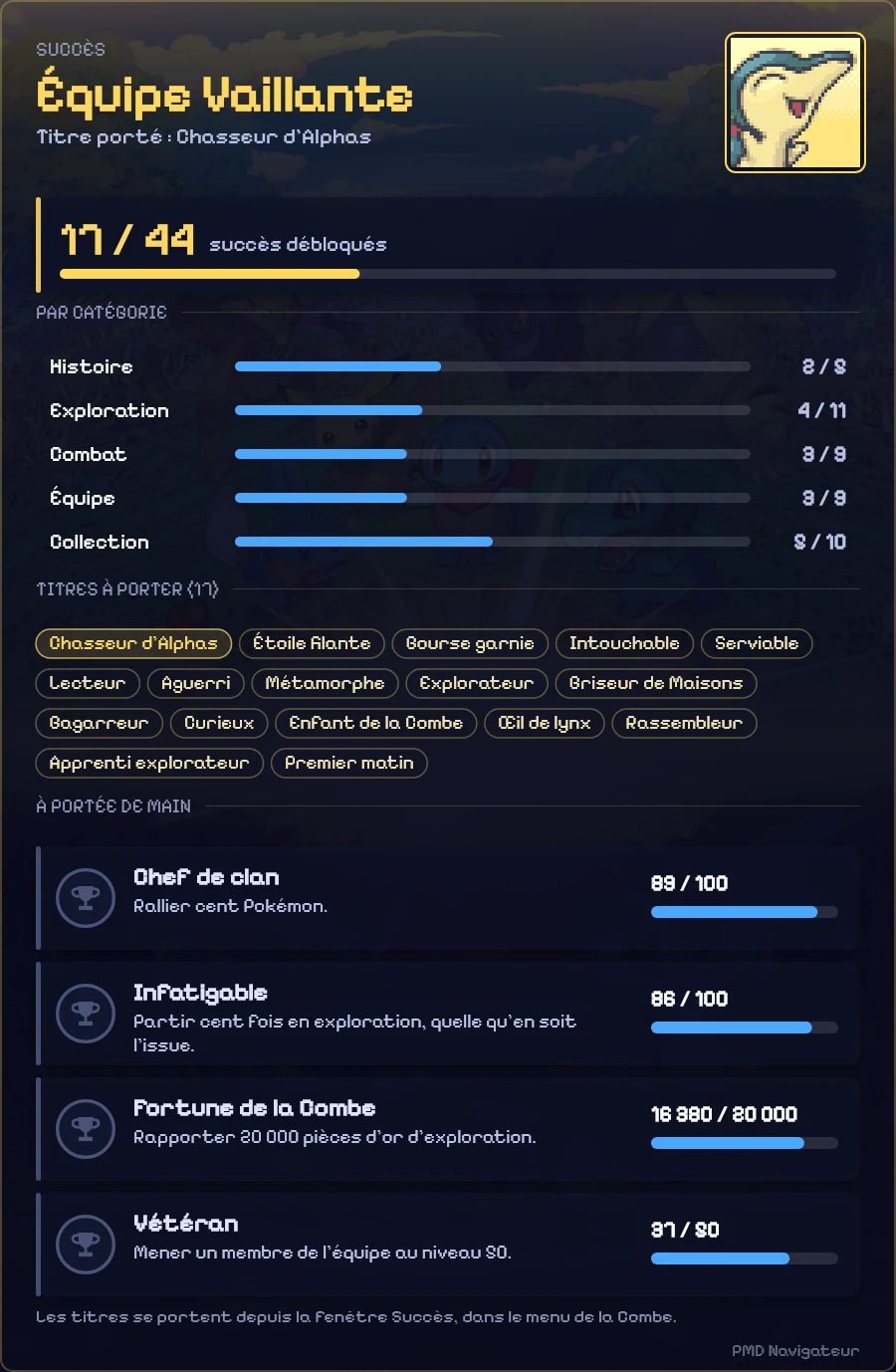
Achievements
Forty-four accomplishments, and a title to wear for each one.
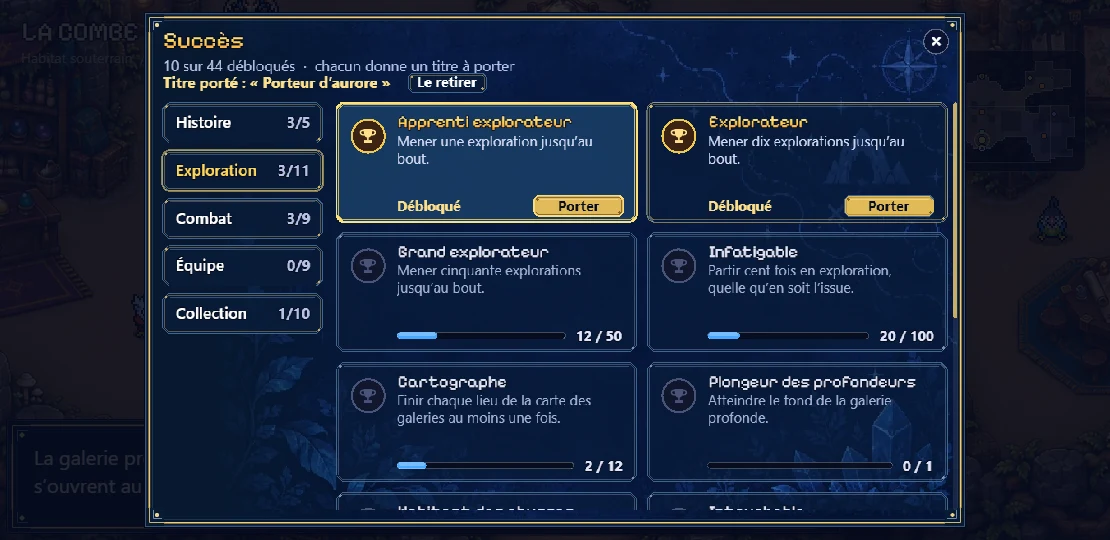
Achievements — forty-four accomplishments in five families (story, exploration, battle, team, collection), found in the Achievements tile of the Hollow menu.
Titles to wear — every unlocked Achievement grants a title, which you pick on its card and which shows in the Hollow menu as well as on Discord.
What you’d already done counts — the story, finished places, Alphas, shinies and your team are all taken into account: when you arrive in the Hollow, your first Achievements drop all at once.
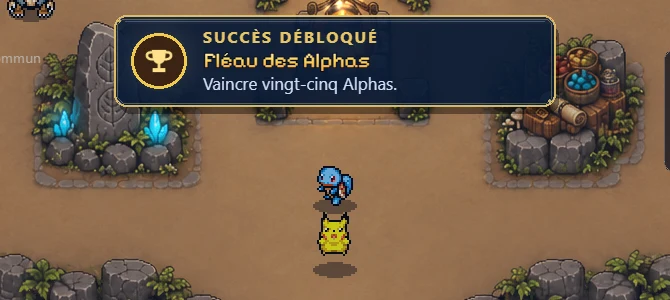
A banner at every unlock — it slides down from the top of the screen, in dungeons as in the Hollow, without interrupting play.
Achievements on Discord — /succès shows yours and everyone else’s, /profil and /classement display your equipped title, a leaderboard ranks the most accomplished, and #succès announces every unlock.
The Warp Trap — it’s gone from the dungeons: no more tile that sends you to the other end of the floor.
Smooth Moves by Touch
Tapping the screen to walk becomes more reliable, in the Hollow as in dungeons.
Walking into the dark — in dungeons, tapping a tile that’s still in darkness moves your Pokémon that way: each step lights up what’s ahead, and it stops as soon as an enemy appears.
A more discreet team frame — on phones, the frame showing HP, experience and hunger shrinks and lets you see more of the dungeon.
Images in your reports — when you report a bug from the game, attach up to four screenshots, picked, dragged or pasted.
Stutters in the Hollow — tapping a spot far from your Pokémon no longer slows the picture down, especially on phones.
The sliding background — the rock visible between the Hollow’s boulders now scrolls with the scenery instead of sliding underneath it.
Pacing back and forth — tapping a wall or the edge of the room brings your Pokémon as close as possible, then it stops instead of pacing around.
Alphas No Longer Negotiate
A pack leader is either fled or fought: it can’t be sweet-talked anymore.
Talking to an Alpha — it won’t even deign to listen anymore: no more conversation, no more calmed pack or offered treasure, and you don’t lose your turn trying.
Alphas recruited too easily — only a knockout can still convince one to follow you, and rarely: 3%, twice that if it’s asleep, a bit more if you outlevel it by several levels.
The Friend Bow was too strong — it now multiplies the recruitment chance by 1.5 instead of adding 10 points, and has no effect at all on an Alpha.
The Map of the Galleries
Thanks to Elsa for the report: nobody gets stuck against Chatot anymore.
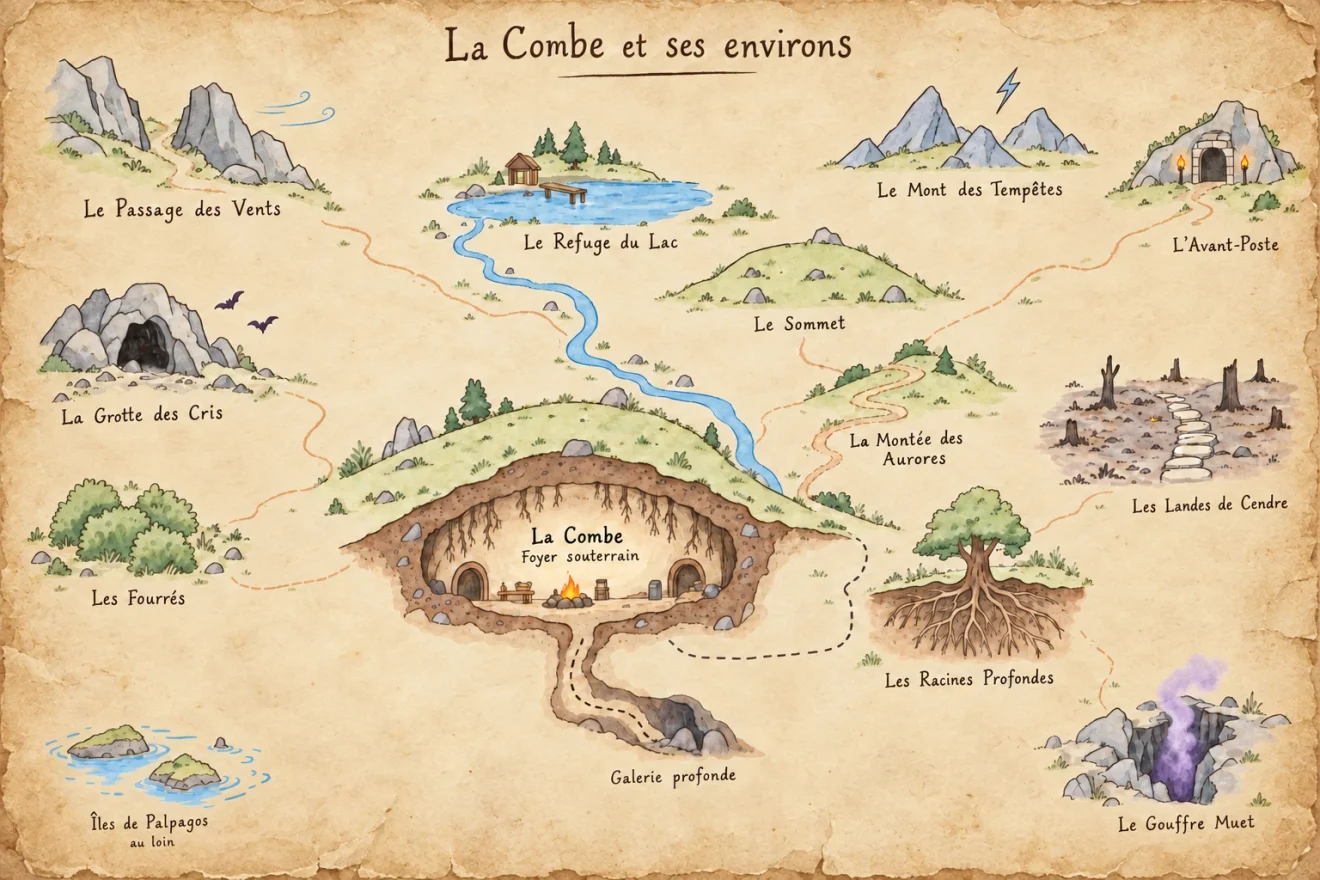
The Map of the Galleries — on the council table, in the chief’s den, a large map keeps track, for every place, of your best descent, the Alphas defeated, and the Monster Houses and minigame rooms you’ve found.
Stuck against a Hollow resident — you can always step away from someone you’re touching, and closing a menu no longer sends strolling residents back to their starting spot.
Special stairs in the wrong place — the golden stairs or the monster stairs are always placed in a room, never in a corridor or in the room with the regular stairs.
The illustrated home screen that vanished last night — the new menu and the redone windows and dialogues are back.
Shinies, Explained
Thanks to Elsa for the report: a shiny no longer slips through your fingers for no reason.
An info card at your first shiny — the first time you run into one, your partner explains how to recruit it, with its real chances of joining you by talking and after a knockout.
An Alpha’s pack that wouldn’t talk anymore — convincing an Alpha calms its pack, but each of its members still listens to whoever comes to talk: a shiny caught up in the pack can finally be recruited.
Treasure that sank — what a wild Pokémon drops over water, lava or a chasm now lands on the nearest shore, Shiny Scale included.
Scenes Without the Wait, a Softer Shadow
A soft-edged shadow — a room’s light blends into the dark instead of stopping at a straight line, and the floor and walls carry on a little into the shadow.
The wait before dungeon scenes — a floor or boss scene starts right away, without showing the room for a second first; the floor banner comes afterward.
Two Touch-Ups in the Story Scenes
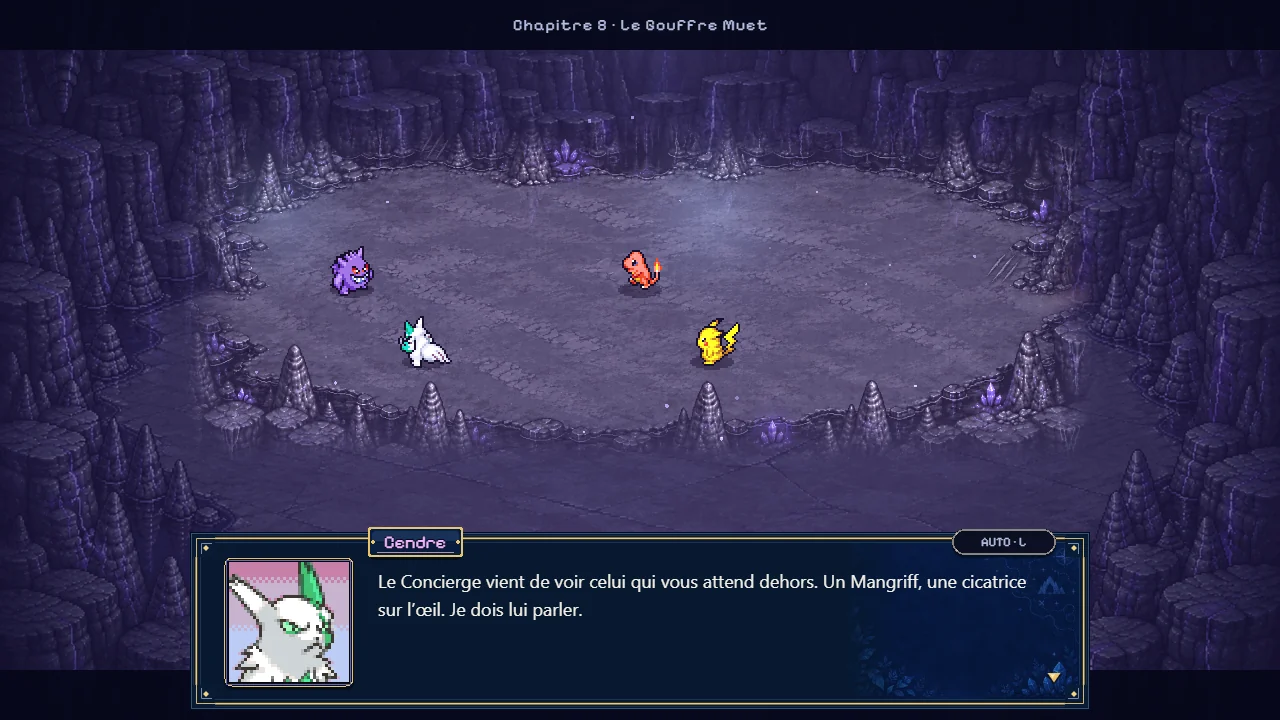
⚠️ Story spoilers (chapitres 4 et 8): details are hidden, hover or tap the bars to read them.
Thanks for the sharp eyes.
See the images (story)
A character in shiny colors — Cinder, Scar’s sister, now has her own colors, sprite and portrait, and her name is written in purple: no more mixing up the two Zangoose.
A character facing the wrong way — Dupin, when facing diagonally downward, looked away from whoever he was talking to; he now faces the person he’s speaking with in every scene.
The Wanderers Finally Show Up
Quicksilver and Sonar no longer play hard to get: you can recruit them before the story ends.
One floor in six — as long as there’s one left to recruit, a wanderer can show up on one floor in six, on top of the other rare encounters.
Recruited before the credits — from chapter 8 on, you run into them often enough to meet them, beat them, then offer them the Apple they ask for.
More Shinies, Wanderers on the Move
The rarest encounters were too rare: almost nobody ever saw them.
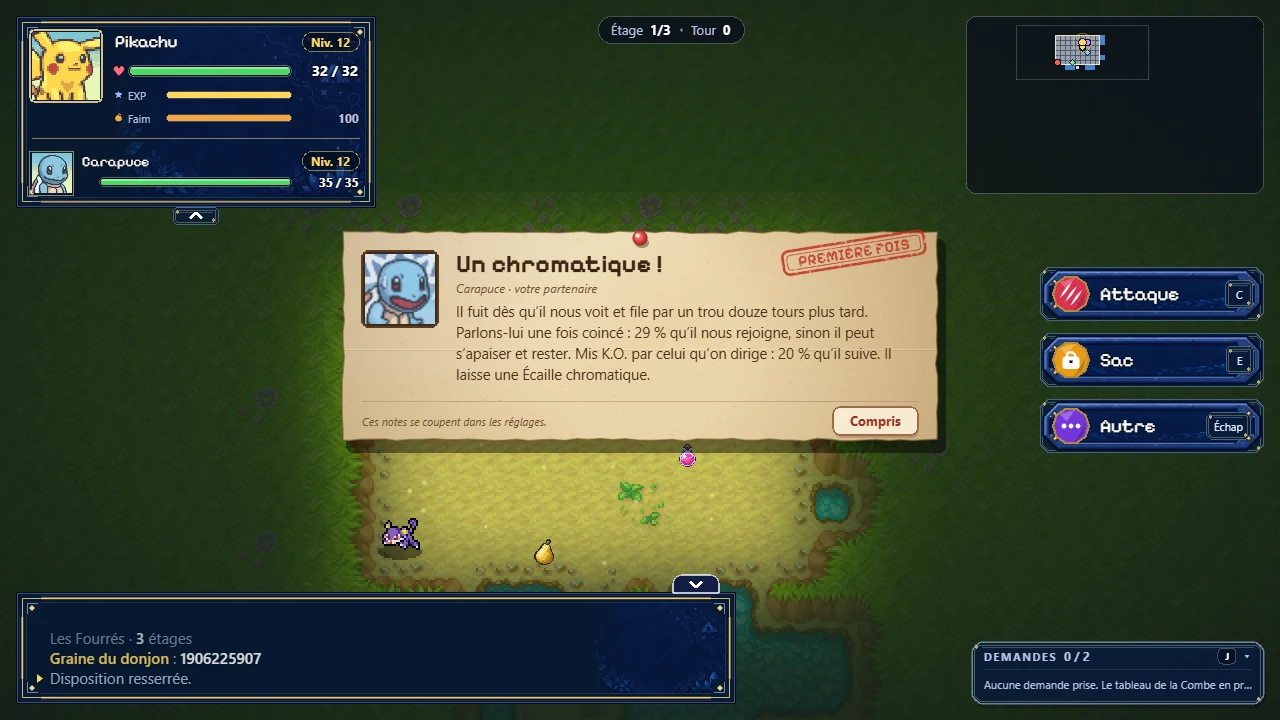
Shinies two and a half times more common — one wild Pokémon in 100 instead of one in 256, from the third floor on: about two over the whole story. It still flees twelve turns after being spotted.
Wanderers who travel — Quicksilver and Sonar show up twice as often, and no longer only in dungeons where their species lives: meeting them three times to recruit them becomes doable.
Who to Revive, and Special Pokémon in the Story
Thanks for your feedback: a fallen ally stays with you, and story dungeons finally hold some surprises.
A fainted ally stays with you — a recruited member who falls no longer heads straight back to camp: it keeps its place in the team frame, down.
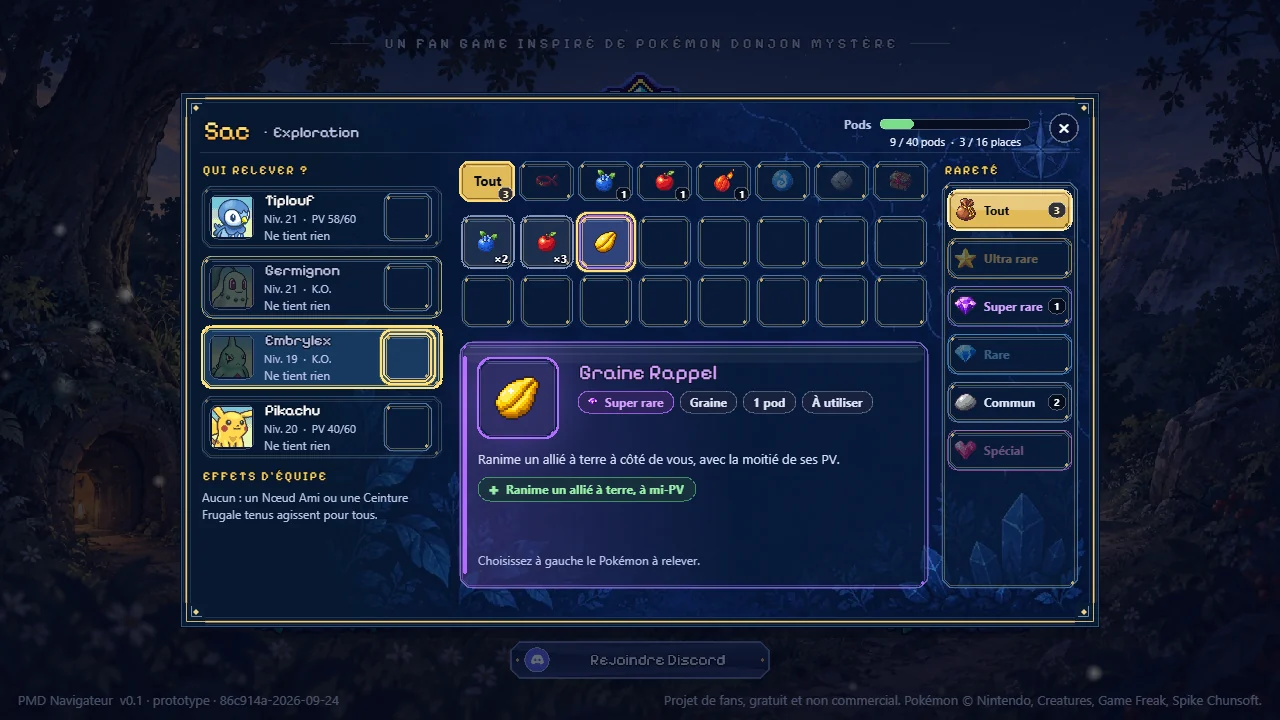
Who to revive? — when several allies are down, the Reviver Seed lets you choose which one gets back up.
Alphas in the story — they now show up in chapter dungeons, and a little more often everywhere: one floor in eight instead of one in ten.
Shinies, rare titles and unique encounters — they too now appear in story dungeons; only the boss floor is safe from surprises.
Reviver Seed with no effect — it no longer answers “nobody is down” when it’s a recruited member who has fallen.
PDMN Opens to Everyone
No more password: the game is open to everyone, and it’s had a head-to-toe makeover. Tell your friends!
No more password — pdmn.fr opens straight onto the game, for everyone.
The whole game gets a makeover — title screen, adventure screen, dialogue windows, pause menu, bank, shop, quest notices and the Map of the Galleries: every screen has been redrawn, in midnight blue and gold.
A woodland for the adventure — the “Your Adventure” screen now opens on Chikorita and Mudkip, by the stream.
Discover the game — below the title screen, a button scrolls down to an introduction: pictures, story, starter Pokémon and FAQ.
Three new pages — the beginner’s guide, the 31 starter Pokémon with the personality quiz table, and this changelog: pdmn.fr/guide, /pokemon and /nouveautes.
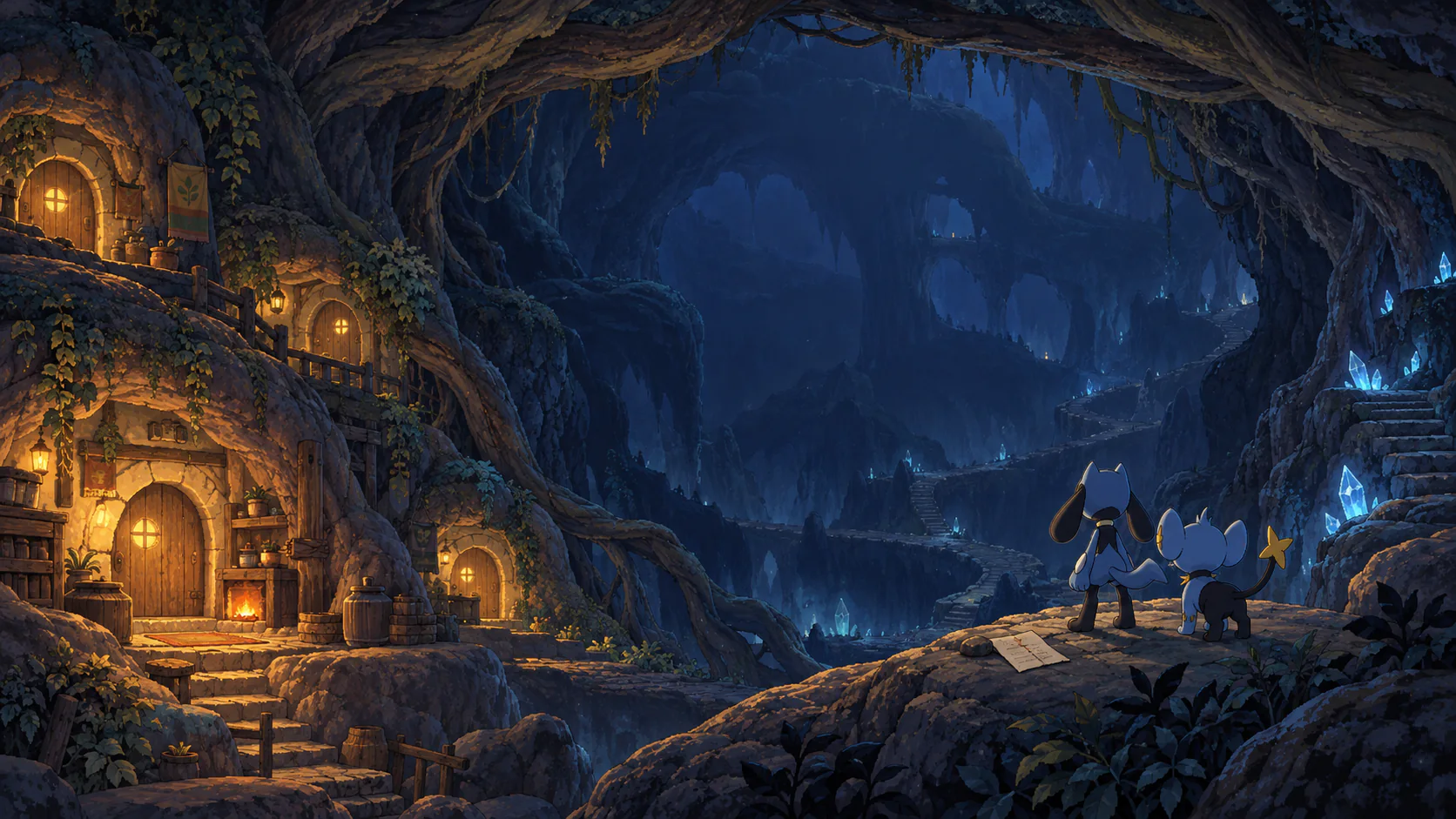
A new loading background — Riolu and Shinx gaze out over the valley while the game wakes up.
Nice previews — a link to pdmn.fr shared on Discord or elsewhere now shows a picture of the game.
The Reviver Seed Finally Answers
Reviver Seed — it now revives an ally who fell on the same floor, instead of saying “nobody is down” until the next floor.
Shove Gust and Magnitude Toned Down
Two moves that ruled the dungeons fall back in line.
Shove Gust — a target slammed into a wall or a Pokémon still loses HP, but is only confused about one time in seven.
Magnitude — the tremor no longer hits the whole room: only the tiles around the user, allies included.
Peaceful and Stay Put
Two new tactics, thanks to Elsa for the idea: your teammates no longer finish off the wild Pokémon you wanted to recruit.
Peaceful — it follows you without ever attacking, up close or from afar: it heals itself, supports the team and leaves you the final blow, the one that recruits.
Stay Put — it stays where it is, even when you move away, and only strikes what comes into contact with it.
Five tactics to choose from — set member by member, in the Hollow as deep in a dungeon.
A sheet that overflowed — the tactic details now fit in the window, and each one says what it really does.
More Room for the Dungeon
On short screens, the log no longer eats up the bottom of the floor.
A log sized to your screen — five lines on a large screen, four on a medium one, three on a small one.
A tab to shrink it — on its top edge, on the right: the log keeps only the last message, and the game remembers your choice from one session to the next.
History always one click away — clicking the log still opens the page of everything that happened.
Bosses That Hold Their Ground
⚠️ Story spoilers (chapitres 3, 7, 8 et 12): details are hidden, hover or tap the bars to read them.
Four story bosses had too little stamina. They’ve pulled themselves together.
The chapter 3 boss — Team Gust, our rivals, can take more punishment and no longer collapses before giving you a scare.
The chapter 7 boss — Oldstone, the Onix of the Ashen Moors, has tripled his HP and finally hits hard: he no longer goes down in three hits.
The chapter 8 boss — the Caretaker, higher level and far tougher, guards the Silent Chasm for real.
The chapter 12 boss — Blaziken: the final battle lasts longer; a Grass-type duo would do well to take cover behind its teammates.
Your Account Linked to Discord
A code, ten minutes, and the server knows who you are.
The /lier command — on the Discord server, the bot gives you a code only you can see, valid for ten minutes.
Enter the code in the game — title screen, Account, Discord section: the bot links your account in a few seconds and confirms it.
For every account — email or Google, no need to ask the team anymore; an account created with Discord stays linked on its own.
What it changes — /profil shows your team, and the leaderboard recognizes you.
No More Hits from the Shadows
A hidden wild Pokémon that strikes you reveals itself, and the moves you set aside stay yours.
The hit lights up its attacker — when a Pokémon out of sight attacks the team, a flash of light reveals it and the tiles around it, just before its hit.
Three turns of light — the area stays lit long enough to strike back, and each new hit rekindles it; with two players, both of you see it.
Set-aside moves unusable — a move you set aside now only applies to what the Pokémon does on its own: when you control it, you can use it.
Clearer Recruitment, Two Bugs Fixed
Thanks for your feedback: your starting team comes back after fainting, and no trap blocks the way anymore.
A lighter recruitment window — portrait, name and level at the top, two badges at most, then Yes or No.
Already in your ranks? — a blue badge shows how many Pokémon of that species are already on the team or in the Hollow.
Where the recruit goes — “Joins the team” with the slot it takes, or “Team full: will go to the Hollow”.
Team replaced after fainting — members who fell along the way take their places back on return, and the run’s recruits wait in the Hollow.
Trap on the only path — a trap is never placed where it would cut the floor in two: there’s always a way around it.
Clearer Item Sheets
Every item finally says what it does, numbers included, and the Molt in the Hollow plays out big.
Redone item sheets — at the bank, in the bag and at the shop, the item is shown large, on a background in its rarity’s color.
Effects in numbers — colored badges say what each item does: HP restored, Belly filled, damage, status, bonus when held.
The essentials at a glance — rarity, family, weight, use and resale price show up as badges under the name.
A tidier bank — how many in storage and how many in the bag, side by side, with the buttons right below.
The Molt, big, in the Hollow — the camp goes dark, the Pokémon wavers between its two forms, then the flash reveals the new one.
Teleported into the middle of a pack — a trap, a seed or a teleport move now sets the team down in a quiet room, far from wild Pokémon.
A portrait that didn’t change — after a Molt, the dungeon team frame properly shows the new form.
Molt and Read Everything from the Hollow
The team sheet gets bigger: you can molt your Pokémon there, take back their items, and read every move in full.
Molting in the Hollow — a Pokémon at the right level molts from its sheet, with one button, without waiting for the next dungeon.
Two clicks to molt — the first asks for confirmation, since a Molt can’t be undone; Eevee and the other forms chosen by location still molt in dungeons.
Remove an item — the held item has its own slot on the sheet, with what it does, and a button puts it back in the bag.
Move details — power, accuracy, range, priority, effects and the types it hits hard or poorly: it’s all there when you hover over a move.
Tactics compared — Balanced, Aggressive and Cautious are picked with a button, and their sheet says how far each one strays and when it heals.
A more readable team — each member has its own card, with its types, its item and a badge when it can molt.
A list that stayed scrolled — the first team member no longer hides when the whole list fits in the window.
Report a Bug from Deep in a Dungeon
No need to go back to the Hollow: a problem mid-exploration can be reported on the spot.
In the Other menu — “Report a bug” opens the same window as in the Hollow, without leaving the floor.
Your exploration attached — the save goes along with the current exploration, so the floor can be seen just as you left it.
The exact spot — the report gives the dungeon, the floor, the special room if there is one, the turn, and whether you were playing together.
A readable report — on the server, each report’s thread sums up the session and its errors, with the files to download.
Report a Bug from the Game
Something wrong mid-game? Tell us without leaving the game: the report reaches the server with everything needed to look at your game.
Report a bug — a new tile in the Hollow menu opens a window where you describe what’s wrong, and how to make it happen again.
Your game attached — your save and the session log go along with the report, so your game can be seen exactly as it is; never your password or your login.
A tracked report — the report arrives in #bug-saves with its own thread, and the team marks it as acknowledged, then fixed.
A three-column menu — the nine tiles of the Hollow menu line up in full rows.
Everyone Keeps Their Own Pokémon, and the Golden Apple Is Rare Again
Two bugs reported on the server, fixed.
The partner who switched sides — after a game together, the host’s partner could leave with their friend on the next run: everyone now keeps their own.
Too many Golden Apples — the only Ultra Rare treasure was dropping everywhere: the Memory Tiles chest now gives a Joy Seed, the Houses no longer hold any, and the ground offers four times fewer.
Talking to Wild Pokémon, and the Controls Screen
Dungeon conversations and the controls screen get a new look.
Speech bubbles — the line is written in a light bubble whose tail points at the speaker, and their portrait lights up with a halo.
A color for each way of answering — heart for kindness, star for flattery, smile for a joke, fangs for a threat, package for a gift.
Personality on a ribbon — at the last word, the wild Pokémon’s nature appears under its name.
A golden banner — the controls screen opens on a gold medallion with the help key floating in it, in front of a watermarked keyboard.
Raised keys — the controls screen shows each key as on a keyboard, and a mouse for what’s done by clicking.
Groups as cards — each group of controls has its own color and drawing, and the two columns are balanced.
Nothing overflows anymore — the controls window takes the height it needs, and long actions wrap onto two lines instead of being cut off.
A regular key grid — three equal columns, with no lonely action stranded in a fourth.
A Real Menu, and Wall Corners
The Hollow menu gets a makeover, and a wall corner no longer steals your diagonal attacks.
A game menu — Escape in the Hollow opens a grid of icon tiles, and an adventure card with the chapter, the purse, the bag and the team’s HP.
The bag in the menu — a Bag tile opens your held and stored items, then takes you back to the menu.
Striking along a wall — a diagonal attack now goes past a wall corner; only two walls that touch block it, and the log says so.
The swing at nothing — a wild Pokémon diagonal to you, next to a wall, dodged your attack with no explanation.
The forgotten fainted partner — with two players, reloading the game made a fallen member vanish.
Moves True to the Games
Every move has its Explorers range and its effects from the games back, and you can now aim before you strike.
Aim before you strike — in the settings, “Move targeting” shows the chosen move’s range; a left click on the target uses it.
Beams reach far — Flamethrower, Hydro Pump, Shadow Ball, Hyper Beam and the other beams hit the first Pokémon up to five tiles away.
Explorers areas — Thunderbolt strikes all around, Heat Wave and Spore cover the room, Explosion blasts two tiles out, and Quick Attack or Fake Out reach two tiles.
Flinching — Bite, Fake Out, Rock Slide, Air Slash and sixteen others can make the target flinch: it loses its next turn.
Evasion instead of Speed — Dragon Dance, Flame Charge, Icy Wind or Mud Shot finally apply their effect, as Evasion.
Effects finally applied — Outrage rampages then confuses, Future Sight hits two turns later, Brick Break breaks walls, Pay Day fills the purse, Dream Eater only works on a sleeping target, Facade and Brine double when they should.
Bonuses handed to the enemy — Charge Beam, Ancient Power or Metal Claw boosted the target, and Superpower weakened it instead of the user: everything now goes to the right Pokémon.
Gather the Team
Your teammates no longer get lost along the way, and one call is enough to bring back those left on the other side of the water.
Gather the team — the U key, or the Other menu: teammates left behind join you at once, for one turn.
Always on your trail — a teammate that falls behind follows your path all the way to you, however long, instead of wandering at random.
It waits for you at the edge — one that can’t swim gets as close to you as it can and waits instead of straying.
Two teammates stuck in place — around a corridor bend, two teammates could swap places endlessly and never move on.
In the Hero’s Footsteps
Teammates walk behind you like in the games, and the swimmers follow you right into the water.
A neat single file — your teammate steps in your footsteps instead of flanking you diagonally.
Bubble reworked — the bubbles travel three tiles in a line, hit harder (35) and can lower Accuracy.
Teammates lost at the water’s edge — a teammate that can swim now crosses pools behind you instead of wandering off.
Wrongly told it “can’t swim” — a swimmer blocked by a wall corner no longer hears that it can’t swim.
Bubble and Speed — the promised Speed drop did nothing: Speed doesn’t exist in this game.
Together, Each at Your Own Pace
The friend who joins you now walks and strikes as fast as you, and nobody waits for the other to move anymore.
The guest walks as fast as the host — their step goes off the instant the key is pressed, without waiting for the round trip through the server: one step every 0.16 s, as in solo, instead of one every 0.28 s.
A connection three times faster — the guest’s moves go through a relay close by and come back in 0.04 s instead of 0.12 s; nobody sees the other player’s address.
Each at your own pace — one player’s step no longer holds back the other’s: each screen plays both players at the same time.
Teammates keep up — on the guest’s side, their teammates, the light and the map follow their hero at the same instant.
See your friend run — when one of you runs, the other screen shows it step for step, and catches up if it has fallen behind.
No more screen starting over from scratch — turning with a click or giving an item to hold knocked both games out of sync, and the guest’s screen reloaded.
Gholdengo’s stall stays with its customer — it also opened for the other player and blocked them; the guest’s purchases now show up right away.
Your friend’s windows stay on their side — their level-up and their Molt question no longer open on your screen.
Every Move Has Its Own Animation
No two attacks alike anymore: every move has its own charge-up, motion and impact, as in Mystery Dungeon.
379 animations, all different — before, 288 moves shared their visuals with another one (Tackle, Double-Edge and Mega Punch were identical, among others).
Motions you can see — dashes with afterimages, projectiles, streams of flame, beams, lobbed throws, and waves and explosions that spread out.
The Pokémon moves to match the attack — it bites, punches, shoots, spins or charges up, instead of the same motion for everything.
The invented moves too — Leg Sweep, Foam Rush, Ember Glyph, Coin Toss and the others have their own staging.
Scyther becomes Kleavor in forests — in the Thickets and the Deep Roots; elsewhere, it still becomes Scizor.
Gifts from the team really arrive — an item or Pokémon given after a bug was overwritten by the game’s save; it’s now stored in your camp.
Fighting Together, Finally Readable
Co-op plays more clearly: you can see when it’s a battle, who has chosen, and whose turn it is.
The battle announces itself — as soon as a wild Pokémon approaches your two heroes, the banner shows “Battle: turn by turn”, before the first hit and not after.
Who has chosen — a green check mark appears above the hero who has chosen their move, and a golden halo shines under yours as long as it’s your turn.
More time to choose — fifteen seconds instead of ten before the absent player’s hero acts by its tactic.
Teammates get past — in a corridor, a teammate blocked by your friend’s hero hops over it, or swaps places with it.
One press, one step — a short press sometimes made you walk twice: the extra step is no longer kept.
No more skipped turns — a wild Pokémon equally far from both heroes acted twice as fast as in solo.
A Proper Goodbye
Releasing a Pokémon now happens in its own window, and it leaves with honors.
A window to confirm — its portrait, its level, what it takes with it, and two buttons: “Keep it”, selected by default, and “Release”, in red.
A farewell — the portrait flies away in sparkles before you return to the team.
The message no longer hides the sheet — “… goes its own way” used to cover the stats; it now stays under the list.
What You Reported
The server’s bugs, one by one, and a request from the ideas channel.
Teammates left at camp no longer vanish — a two-player run only takes the hero and one teammate; the others evaporated on return, neither on the team nor in the dormitory.
The hero at the shared level finally gains experience — sitting right at the cap from the start, they didn’t gain a single point the whole run.
The stairs become a proposal — with two players, whoever reaches the stairs proposes going down, and the other sees the same floor card before answering: nobody wakes up on a different floor anymore.
A downed hero hands over — control passes on its own to one of their Pokémon still standing, and the camera no longer jumps to your friend.
A move pressed while waiting is no longer lost — pressing Attack during the countdown did nothing; and a turn lost in transit now catches up on its own.
A thrown item no longer crosses the whole room — five tiles instead of ten: it was the only way to strike without risking a counterattack, while moves reach two or three.
The stall can be scrolled — by touch, with the mouse wheel, or by dragging its scrollbar: the last row of goods was out of reach.
Release a Pokémon — its tactic sheet offers to set it free, with a second prompt before it leaves.
The bot knows every Molt — `/dex` only announced the duo’s evolution; it now gives every species’ Molt, and the level where it happens.
Together, Everyone Goes Home
A two-player run finally leaves you with something: each of you returns to your own Hollow with what’s yours.
Your share comes home with you — your Pokémon, your bag, your coins and your recruits return to your Hollow; the summary, board requests and Sealed Boxes are settled just as in solo.
Your real level, and the experience set aside — whoever played at their friend’s level gets their own level back on return, with all the experience earned along the way; a newly learned move takes a free slot.
Down, you leave your bag behind — if your hero is down at the end of the run, your bag and purse stay in the dungeon, as after fainting in solo; your friend goes home with theirs.
Giving up only costs you — whoever gives up leaves their bag behind; the other goes home standing, bag included, and the screen tells them so.
Together, the Welcome Scroll
A scroll on arrival — when playing together, the dungeon starts by explaining in four lines how it works: each at your own pace, turn by turn in front of the same wild Pokémon, the banner, and what you share.
“Don’t show again” — a second button puts it away for good; “Got it” closes it until the next run.
Together, Each with Your Own Clock
Each of you moves at your own pace: what surrounds you only lives when you play, and your friend only waits for your move when you face the same wild Pokémon.
Nobody waits for anybody — a step, a hit, an item go off right away; a friend exploring elsewhere is never held up by your battle anymore.
Your wild Pokémon only move when you play — wild Pokémon, teammates and statuses run on the clock of the nearest hero: while you think, nothing around you moves, even if your friend is running.
Facing the same wild Pokémon, turn by turn — if your move would make a wild Pokémon within your friend’s reach act, it waits for their choice: ten seconds, then their tactic; “X is choosing…” and “Your turn” say so.
No more waiting on steps — the twenty-second wait announced this morning is gone: an explorer’s step no longer depends on their friend’s battle.
Together, Each with Your Own Battle
The turn only waits for whoever is fighting — if your friend is exploring another room while you face a wild Pokémon, you play without waiting for them; they’re only held up if a wild Pokémon is in sight on their side.
Their steps wait for your move — while you think, your calm friend’s step waits without rushing you: their banner says you’re fighting, yours says they’re waiting on your move; they give you twenty seconds before your tactic plays.
Countdown between fighters only — the ten seconds only start if a friend in battle has already chosen.
Together, You See Who You’re Waiting For
A banner under the floor bar — facing a wild Pokémon, it says who is choosing and how many seconds are left; “Your turn” when it’s your friend who is waiting. At zero, the log says who acted by their tactic.
Turning costs nothing — with two players, turning no longer goes through the turn or waits for your friend: you turn, then strike.
No more double moves — a step that arrived late could be replayed on the next turn; each screen now sends nothing until its own step has gone through.
Together, a Step Is a Step
No more bursts of steps — with two players, a key held while the turn waited for your friend stacked up five or six steps at once; each screen now waits for the turn containing its step before asking for another.
Multiplayer on the adventure screen — the “Play Together” card there opens the invitation and heads straight into the dungeon; on the departure sheet, the button sits next to “Set Out”.
Play Together, First Try
A friend, a five-letter code, and the same dungeon for two: the first version of co-op is here, for the curious.
Play Together — on the departure sheet: one player invites with a five-letter code, the other enters it. You need to be logged in to your account, and you both need to have been through the chosen dungeon.
Each with your own hero — each of you walks whenever you like; facing a wild Pokémon, each picks a move, and the turn goes off when both have chosen, or after ten seconds.
Each with your own bag — bag, purse and Belly for each; what a hero picks up is theirs, and coins found are shared.
Not there yet — nothing comes back to camp for now, no items, no recruits, no experience: it’s a first try. Tell us on Discord what’s off.
Under the Hood, a Table for Two
Nothing changes in solo, but the engine can now have two players in the same dungeon: the first building block of co-op.
Seats at the table — each player will have their own hero, bag, purse and Belly; the turn has both act before teammates and wild Pokémon.
Solo, just the same — same game, same rules, same save; if anything feels different, tell us on Discord.
Pick Up Exactly Where You Left Off
Reloading mid-dungeon now resumes the game exactly as it was, and the title screen shows which version is running.
Faithful resume — after reloading the page, wild Pokémon act in the same order as before, the floor’s wildlife stays the same, and a wild Pokémon that flies or swims no longer disappears.
Version number — at the bottom of the title screen, so you know which version you’re talking about when you report something.
A Map You Can Read, and a Plan of the Hollow
The floor map has been redone from top to bottom, and the Hollow finally has its own: small in the corner, big in the middle, or put away.
Three sizes — the Map key cycles through them: small in the top right, big in the middle of the screen with its title and legend, or hidden; the Other menu and the pause menu offer it too, and your choice is remembered.
A floor map that makes sense — corridors drawn as connected lines, rooms outlined (yours in gold), water, lava and chasms in their own colors, and what’s on screen overlaid.
Everything that matters, marked — the stairs, discovered traps, embers, items in their category’s color (a treasure pulses), wild Pokémon, bosses circled with a ring, and the hero’s arrow.
The plan of the Hollow — the floor tinted area by area, the furniture and rocks, the three doors and what lies behind them, the bank, the shop, quests and moves at their signs, the breathing hearth, the mouth of the gallery.
Who is where — keepers, visitors and allies glide across the plan just as on screen; the dens and the dormitory have their own.
By touch — tapping the Hollow’s plan enlarges it, tapping it again shrinks it.
Nineteen Moves Only This Dungeon Knows
Moves invented for this game, which each type learns at a given level: they push, pull, trap, protect and read the floor.
They move things around — Shove Gust (Flying, Lv. 13) pushes the target back two tiles and stuns it against an obstacle; Vine Grapple (Grass, 12) pulls it into contact and seeds it; Foam Rush (Water, 14) leaps in front of it before striking; Leg Sweep (Fighting, 11) binds it; Swap Places (Psychic, 16) swaps places with the first Pokémon in front of the user
They trap the room — Ember Glyph (Fire, 17) lights embers around the user for five turns; Dug Pit (Ground, 15) sets a real trap in front of the user, one that only waits for wild Pokémon; Web Snare (Bug, 11) catches every opponent in the room for six turns
They mark — Hunter’s Mark (Dark, 18): the target takes half again as much damage and can no longer heal; Erosion (Rock, 15) eats away at its max HP with every hit, until the end of the floor
They protect — Scale Shield (Steel, 14) absorbs forty damage; Echo Back (Psychic and Fairy, 25) sends back half of the hits taken; Guard’s Sacrifice (Fighting, 23) takes the hits aimed at an adjacent ally; Pack Howl (Normal, 21) draws allies closer and raises their Attack; Lure (Normal, 9) draws every wild Pokémon in the room to the user
They live off the dungeon — Loot Scent (Normal and Ground, 20) reveals items, traps and the stairs on the map; Coin Toss (Normal and Steel, 30) throws fifty coins in the target’s face; Shared Ration (Normal and Grass, 24) gives a fifth of the hero’s Belly to heal allies; Last Breath (Ghost and Poison, 19) makes whoever knocks out its holder lose half their HP
Wild Pokémon too — those of these types use them, except the six that only make sense in the team’s paws: Swap Places, Dug Pit, Lure, Loot Scent, Coin Toss and Shared Ration; the Move Master can bring them back to mind like any other
Embers you can see — hot ash, glowing embers and sparks on Ember Glyph’s tiles
Fire Spin borrowed Flamethrower’s fireball — it now has its own sequence: flames swirl around the user, then close in on the target
Multi-Hit Moves, Moves That Target Held Items, and Winds That Push
Three promises from the move sheets that the engine wasn’t keeping yet.
Several hits in a row — Fury Attack, Fury Swipes, Pin Missile, Double Slap, Comet Punch, Bone Rush, Arm Thrust, Water Shuriken and Rock Blast hit 2 to 5 times, each hit dealing its own damage; Twineedle, Double Kick, Bonemerang, Dual Chop and Double Hit hit twice. “Hit 3 times!” says so
Valued properly — teammates and wild Pokémon take these repeated hits into account when choosing what to use
Knock Off — knocks away the item the target is holding, and hits half again as hard if it was holding one
Covet — steals the target’s held item when the user’s paws are free; otherwise, the item falls to the ground
Bug Bite and Pluck — eat the Berry the target is holding, and the user gets its effect
Winds push — Gust, Twister, Fairy Wind, Ominous Wind and Silver Wind push the target one tile, if nothing holds it back: a wall, another Pokémon or water stops it, and a boss doesn’t budge
An invisible item — the one knocked away by Trick or Switcheroo couldn’t be seen until a reload
The Dungeons Breathe: Local Air, Glows and Footprints
On top of yesterday’s soft light, every place now has its own air, its glows and its tracks.
The air of each place — embers rising in the Ashen Moors, crystals drifting underground, pollen in the Thickets, snowflakes on Aurora Climb, sand streaming through Wind Pass, sleet on Mount Tempest
Mount Tempest’s lightning — distant lightning flashes the screen white now and then, even without rain; in the rain, each flash reveals the whole floor for an instant
Glows — lava lights up the ground around it, and the stairs glow faintly once found
The flame of Fire-type Pokémon — reaches farther in corridors, and a Flamethrower or Thunderbolt lights up the room for the length of the hit
Footprints — prints in the snow, dust on sand, ash in the Moors, leaves kicked up in forests, ripples on the water you walk along. Those who fly or float leave nothing behind
Light that rises — when you enter a room, it comes up over a fraction of a second instead of all at once, and fades out behind you
Rare items sparkle — Super Rare, Ultra Rare and Special items shine on the ground, in their rarity’s color
The Molt, Mid-Dungeon
⚠️ Story spoilers (chapitre 10): details are hidden, hover or tap the bars to read them.
At the level of its next form, a Pokémon can molt on the spot, in the middle of exploring. Wild Pokémon do the same.
Molt without waiting — at the right level, the game offers “Molt” or “Not now”. If you decline, the Molt comes back at the next level, and stays available from the team window, at the cost of one turn
What the Molt brings — half its HP restored, status conditions cured, a burst of Attack, adjacent opponents pushed back one tile, and the new form’s move learned
110 Molts, all the way to final forms — Caterpie ends up as Butterfree, Charmeleon becomes Charizard at level 36. 56 species join the game for this
Eevee chooses by location — Leafeon in forests, Jolteon in thunderstorms, Flareon in the ashes, Glaceon under the auroras, Espeon at the summit, Umbreon in caves, Vaporeon elsewhere, Sylveon if it knows a Fairy move. Gloom becomes Bellossom in the sun, Vileplume otherwise
Wild Pokémon molt too — one that knocks out one of yours changes form on the spot: stronger, and worth more experience
An aura for final forms — in their type’s color, in dungeons as in the Hollow
A MOLT badge — on the team frame and the Hollow sheet, it shows who can molt and at what level. The return summary counts the Molts
The hero and the partner — keep the Molt the story holds for them in chapter 10, then molt by level like everyone else
Two touch-ups — Berries fill up whoever eats them a little, and Tri Attack burns, freezes or paralyzes at random
Adjustable Dungeon Brightness
The dungeons get a little darker, and everyone can choose how bright they are.
Slightly less bright scenery — the Pokémon themselves stay sharp
A new setting — “Dungeon brightness”, from 50 to 100%, in the Settings of both the Hollow and the dungeon: the change shows immediately
Dungeon Lighting, and Moving Water
Dungeons have their own light: the room you’re standing in lights up, and the rest fades into the place’s shadow. Water and lava move like in the Mystery Dungeon games.
The room lights up — the one you’re standing in, and its light blends gently into the shadow instead of stopping abruptly
A halo in corridors — round, it follows the team step by step
You can make out the place — around what you’ve explored, forest, rock or lava replace the midnight-blue void
Water and lava move — with the animation frames from the games, embers too, in eight places
Weather covers the whole screen — rain, sun and storms
A Clearer Team Frame, and Swipe to Turn
The team frame reads at a glance, on computers and phones alike. By touch, no more D-pad: tap to go, swipe to turn.
A more compact frame — the hero fits on three lines, and the numbers are right-aligned
One line per member — with its HP gauge; the collapsed team keeps its HP in view under each portrait
A thin bar at the top — floor, turn, purse and weather go there
Swipe to turn — on phones, swiping toward a direction turns the hero that way, without taking a step or using a turn
No more D-pad — on phones, tapping a tile is enough to go there, in dungeons as in the Hollow
A bubble for the gesture — it explains it the first time, and the controller no longer hides the help bubbles
Text that overflowed — the floor and weather text spilled out of the team frame
A lost first tap — on phones, collapsing the team took two taps
One step too many — tapping the team frame made the hero walk toward the tile hidden underneath
A Poké Ball for Species Already Recruited
In dungeons, you can see at a glance who’s still missing from the crew.
A Poké Ball above wild Pokémon — as soon as their species is already on your team or in your dormitory
On the fly — as soon as a wild Pokémon joins the team, others of its kind wear the ball in turn
No More Unwanted Zoom on Phones
The on-screen controller no longer makes the page move.
Page zoom — quickly double-tapping the D-pad, or putting two thumbs down at once, zoomed the page, especially on iPhone
Lost taps — while a thumb held the D-pad, a tap on the map was ignored, and a press on the controller could reach whatever was behind it
Phones, More Comfortable
On phones, windows are finally readable, and the Hollow can be explored by touch.
The Hollow by touch — tapping a tile takes your hero there; tapping a resident walks you up to talk to them, and tapping a counter opens it
Dialogues too — tapping the screen advances the ones in the Hollow
Readable windows — on phones, text gets bigger and switches to a more readable font: bag, shop, bank, request board, departure sheet, team sheet, settings, title screen and hero selection
Full descriptions — item descriptions and help bubbles can be read to the end
Back and Confirm on the side — in windows, they no longer cover the bottom
The game shrunk on iPhone — it could end up in the middle of the screen after rotating the phone
PMD Navigateur Comes to Phones
The game can now be played on phones, in landscape, with an on-screen controller. On computers, nothing changes, except a much faster startup.
Fullscreen and landscape — from the first tap; on iPhone, a screen invites you to rotate the device
An on-screen controller — a console-style D-pad, Attack, Confirm, Menu, and buttons to open moves and the bag, talk, wait, run or turn in place
Tap to go — in dungeons, tapping a tile takes your hero there, and tapping an adjacent enemy attacks it; walking stops as soon as danger shows up
Everything works by touch — the bag, menus and windows
Bigger on phones — the dungeon interface, and dialogues and letters are written larger
A much faster startup — on computers too: the big illustrations are four times lighter and only load when they’re needed
Sound on phones — it starts properly, iPhone included, even after a call
The bag and the menu — closing the bag with the keyboard also opened the dungeon menu
Dungeons That Repopulate
Floors no longer stay empty, and the first dungeons have more wild Pokémon.
More wild Pokémon early on — the Thickets, the Cave of Cries and Wind Pass have more on every floor
A cleared floor repopulates — new wild Pokémon arrive out of sight as the turns go by, never exceeding the starting population
More encounters — that means more experience and more recruits: you leave the first dungeons a level higher
Dungeon weather — the weather specific to certain places never kicked in: Wind Pass’s sandstorms finally blow
Teammates Who Obey, Moves That Tell the Truth
Your teammates finally follow your orders, and every move does exactly what its sheet says.
A tactic per teammate — Balanced, Aggressive or Cautious: it changes how it attacks and moves
Moves you can set aside — each one can be allowed or not, Pokémon by Pokémon, in dungeons as in the Hollow (team sheet → Adjust)
The Cautious one backs off — when worn out, it avoids trading blows
Counter, Mirror Coat and Metal Burst — return the hit just taken on the spot
False Swipe — spares the target and makes it twice as easy to recruit
Natural Gift — takes on the type and power of the held Berry
Dozens of moves made faithful — recoil, charge-up turns, variable power: they get their true character back
A confirmation before exploding — Explosion, Self-Destruct and Memento ask for it before taking the hero down
Online save — its window is clearer
An explosion into thin air — it left its user standing
A teammate who blew itself up — it could decide to explode on its own
Fling with nothing — a wild Pokémon with no item stood there trying it again and again
Phantom counters — a counterattack came from a Pokémon already down, or reached someone who had moved away
Sheets that lied — they promised towns, Pokémon Centers or an initiative stat that don’t exist here